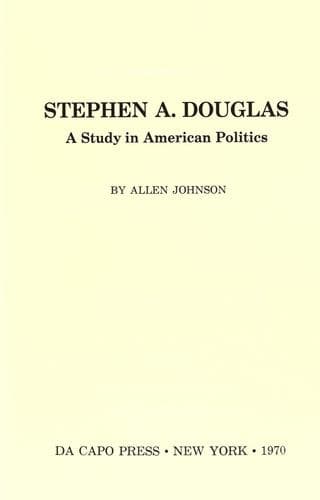
Stephen A. Douglas: A Study in American PoliticsJohnson, Allen
History
Stephen A. Douglas: A Study in American Politics
Johnson, Allen
Douglas, Stephen A. (Stephen Arnold), 1813-1861
Early in the fall, on his return from a Southern trip, Douglas called
upon the President in Washington. He was cordially welcomed, and not a
little flattered by Polk's readiness to talk over the political
situation before Congress met.[235] Evidently his support was
earnestly desired for the contemplated policies of the administration.
It was needed, as events proved. No sooner was Congress assembled than
the opposition charged Polk with having exceeded his authority in
organizing governments in the territory wrested from Mexico. Douglas
sprang at once to the President's defense. He would not presume to
speak with authority in the matter, but an examination of the
accessible official papers had convinced him that the course of the
President and of the commanders of the army was altogether defensible.
"In conducting the war, conquest was effected, and the right growing
out of conquest was to govern the subdued provinces in a temporary and
provisional manner, until the home government should establish a
government in another form."[236] And more to this effect, uttered in
the heated language of righteous indignation.
For thus throwing himself into the breach, Douglas was rewarded by
further confidences. Before Polk replied to the resolution of inquiry
which the House had voted, he summoned Douglas and a colleague to the
White House, to acquaint them with the contents of his message and
with the documents which would accompany it, so "that they might be
prepared to meet any attacks." And again, with four other members of
the House, Douglas was asked to advise the President in the matter of
appointing Colonel Benton to the office of lieutenant-general in
command of the armies in the field. At the same time, the President
laid before them his project for an appropriation of two millions to
purchase peace; _i.e._ to secure a cession of territory from Mexico.
With one accord Douglas and his companions advised the President not
to press Benton's appointment, but all agreed that the desired
appropriation should be pushed through Congress with all possible
speed.[237] Yet all knew that such a bill must run the gauntlet of
amendment by those who had attached the Wilmot Proviso to the
two-million-dollar bill of the last session.
Public-domain text, read in full here on John Shaqi.
Reviews
Reviews
No reviews yet
Be the first to share your thoughts on this work.
Elsewhere in the archive
Join the Discussion
Join the discussion
Sign in to leave a comment or review.
Sign InorCreate an account