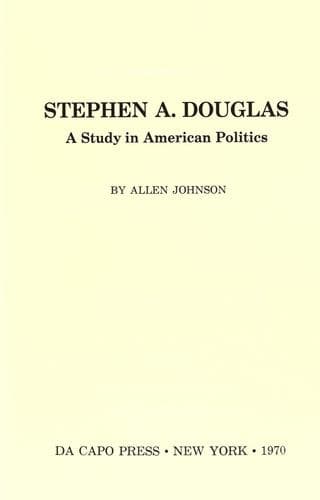
Stephen A. Douglas: A Study in American PoliticsJohnson, Allen
History
Stephen A. Douglas: A Study in American Politics
Johnson, Allen
Douglas, Stephen A. (Stephen Arnold), 1813-1861
Immediately upon taking his seat in the Senate, Douglas was appointed
chairman of the Committee on Territories. It was then a position of
the utmost importance, for every question of territorial organization
touched the peculiar interests of the South. The varying currents of
public opinion crossed in this committee. Senator Bright of Indiana is
well described by the hackneyed and often misapplied designation, a
Northern Democrat with Southern principles; Butler was Calhoun's
colleague; Clayton of Delaware was a Whig and represented a border
State which was vacillating between slavery and freedom; while Davis
was a Massachusetts Whig. Douglas was placed, as it appeared, in the
very storm center of politics, where his well-known fighting qualities
would be in demand. It was not so clear to those who knew him, that he
possessed the not less needful qualities of patience and tact for
occasions when battles are not won by fighting. Still, life at the
capital had smoothed his many little asperities of manner. He had
learned to conform to the requirements of a social etiquette to which
he had been a stranger; yet without losing the heartiness of manner
and genial companionableness with all men which was, indeed, his
greatest personal charm. His genuineness and large-hearted regard for
his friends grappled them to him and won respect even from those who
were not of his political faith.[240]
An incident at the very outset of his career in the Senate, betrayed
some little lack of self-restraint. When Senator Cass introduced the
so-called Ten Regiments bill, Calhoun asked that its consideration
might be postponed, in order to give him opportunity to discuss
resolutions on the prospective annexation of Mexico. Cass was disposed
to yield for courtesy's sake; but Douglas resented the interruption.
He failed to see why public business should be suspended in order to
discuss abstract propositions. He believed that this doctrine of
courtesy was being carried to great lengths.[241] Evidently the young
Senator, fresh from the brisk atmosphere of the House, was restive
under the conventional restraints of the more sedate Senate. He had
not yet become acclimated.
Public-domain text, read in full here on John Shaqi.
Reviews
Reviews
No reviews yet
Be the first to share your thoughts on this work.
Elsewhere in the archive
Join the Discussion
Join the discussion
Sign in to leave a comment or review.
Sign InorCreate an account