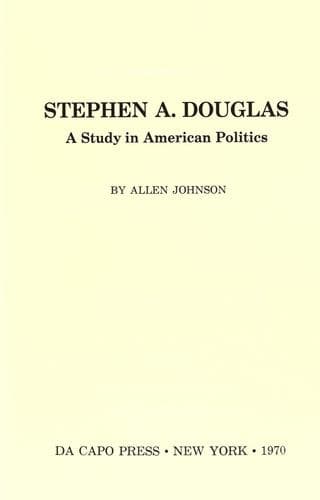
Stephen A. Douglas: A Study in American PoliticsJohnson, Allen
History
Stephen A. Douglas: A Study in American Politics
Johnson, Allen
Douglas, Stephen A. (Stephen Arnold), 1813-1861
Douglas made his first formal speech in the Senate on February 1,
1848. Despite his disclaimers, he had evidently made careful
preparation, for his desk was strewn with books and he referred
frequently to his authorities. The Ten Regiments bill was known to be
a measure of the administration; and for this reason, if for no other,
it was bitterly opposed. The time seemed opportune for a vindication
of the President's policy. Douglas indignantly repelled the charge
that the war had from the outset been a war of conquest. "It is a war
of self-defense, forced upon us by our enemy, and prosecuted on our
part in vindication of our honor, and the integrity of our territory.
The enemy invaded our territory, and we repelled the invasion, and
demanded satisfaction for all our grievances. In order to compel
Mexico to do us justice, it was necessary to follow her retreating
armies into her territory ... and inasmuch as it was certain that she
was unable to make indemnity in money, we must necessarily take it in
land. Conquest was not the motive for the prosecution of the war;
satisfaction, indemnity, security, was the motive--conquest and
territory the means."[242]
Once again Douglas reviewed the origin of the war re-arguing the case
for the administration. If the arguments employed were now well-worn,
they were repeated with an incisiveness that took away much of their
staleness. This speech must be understood as complementary to that
which he had made in the House at the opening of hostilities. But he
had not changed his point of view, nor moderated his contentions. Time
seemed to have served only to make him surer of his evidence. Douglas
exhibited throughout his most conspicuous excellencies and his most
glaring defects. From first to last he was an attorney, making the
best possible defense of his client. Nothing could excel his adroit
selection of evidence, and his disposition and massing of telling
testimony. Form and presentation were admirably calculated to disarm
and convince. It goes without saying that Douglas's mental attitude
was the opposite of the scientific and historic spirit. Having a
proposition to establish, he cared only for pertinent evidence. He
rarely inquired into the character of the authorities from which he
culled his data.
Public-domain text, read in full here on John Shaqi.
Reviews
Reviews
No reviews yet
Be the first to share your thoughts on this work.
Elsewhere in the archive
Join the Discussion
Join the discussion
Sign in to leave a comment or review.
Sign InorCreate an account