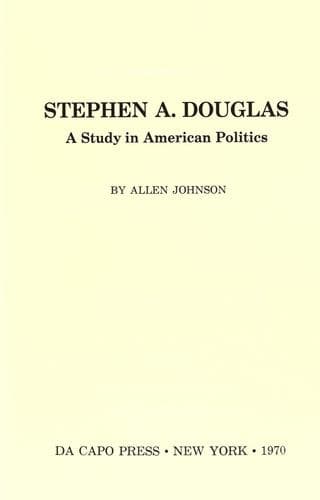
Stephen A. Douglas: A Study in American PoliticsJohnson, Allen
History
Stephen A. Douglas: A Study in American Politics
Johnson, Allen
Douglas, Stephen A. (Stephen Arnold), 1813-1861
This was not the only ground of complaint. Douglas afterward stated
the feeling of the minority in this way: "It violated a great
principle of public policy in relation to this continent. It pledges
the faith of this Republic that our successors shall not do that which
duty to the interests and honor of the country, in the progress of
events, may compel them to do." But he hastened to add that he
meditated no aggression upon Mexico. In short, the Republic,--such was
his hardly-concealed thought,--might again fall out with its imbecile
neighbor and feel called upon to administer punishment by demanding
indemnity. There was no knowing what "the progress of events" might
make a national necessity.[243]
As yet Douglas had contributed nothing to the solution of the problem
which lurked behind the Mexican cession; nor had he tried his hand at
making party opinion on new issues. He seemed to have no concern
beyond the concrete business on the calendar of the Senate. He classed
all anticipatory discussion of future issues as idle abstraction. Had
he no imagination? Had he no eyes to see beyond the object immediately
within his field of vision? Had his alert intelligence suddenly become
myopic?
On the subject of Abolitionism, at least, he had positive convictions,
which he did not hesitate to express. An exciting episode in the
Senate drew from him a sharp arraignment of the extreme factions North
and South. An acrimonious debate had been precipitated by a bill
introduced by that fervid champion of Abolitionism, Senator Hale of
New Hampshire, which purported to protect property in the District of
Columbia against rioters. A recent attack upon the office of the
_National Era_, the organ of Abolitionism, at the capital, as everyone
understood, inspired the bill, and inevitably formed the real subject
of debate.[244] It was in the heated colloquy that ensued that Senator
Foote of Mississippi earned his sobriquet of "Hangman," by inviting
Hale to visit Mississippi and to "grace one of the tallest trees of
the forest, with a rope around his neck." Calhoun, too, was excited
beyond his wont, declaring that he would as soon argue with a maniac
from Bedlam as with the Senator from New Hampshire.
Public-domain text, read in full here on John Shaqi.
Reviews
Reviews
No reviews yet
Be the first to share your thoughts on this work.
Elsewhere in the archive
Join the Discussion
Join the discussion
Sign in to leave a comment or review.
Sign InorCreate an account