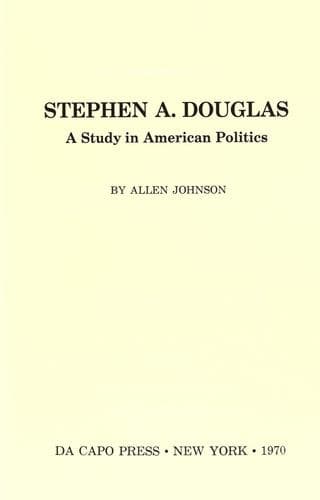
Stephen A. Douglas: A Study in American PoliticsJohnson, Allen
History
Stephen A. Douglas: A Study in American Politics
Johnson, Allen
Douglas, Stephen A. (Stephen Arnold), 1813-1861
When Douglas entered Washington in the fall of 1847, as junior Senator
from Illinois, our troops had occupied the city of Mexico and
negotiations for peace were well under way. Perplexing problems
awaited Congress. President Polk sternly reminded the two Houses that
peace must bring indemnity for the past and security for the future,
and that the only indemnity which Mexico could offer would be a
cession of territory. Unwittingly, he gave the signal for another
bitter controversy, for in the state of public opinion at that moment,
every accession of territory was bound to raise the question of the
extension of slavery. The country was on the eve of another
presidential election. Would the administration which had precipitated
the war, prove itself equal to the legislative burdens imposed by that
war? Could the party evolve a constructive programme and at the same
time name a candidate that would win another victory at the polls?
It soon transpired that the Democratic party was at loggerheads. Of
all the factions, that headed by the South Carolina delegation
possessed the greatest solidarity. Under the leadership of Calhoun,
its attitude toward slavery in the Territories was already clearly
stated in almost syllogistic form: the States are co-sovereigns in the
Territories; the general government is only the agent of the
co-sovereigns; therefore, the citizens of each State may settle in the
Territories with whatever is recognized as property in their own
State. The corollary of this doctrine was: Congress may not exclude
slavery from the Territories.
At the other pole of political thought, stood the supporters of the
Wilmot Proviso, who had twice endeavored to attach a prohibition of
slavery to all territory which should be acquired from Mexico, and who
had retarded the organization of Oregon by insisting upon a similar
concession to the principle of slavery-restriction in that Territory.
Next to these Ultras were those who doubted the necessity of the
Wilmot Proviso, believing that slavery was already prohibited in the
new acquisitions by Mexican law. Yet not for an instant did they doubt
the power of Congress to prohibit slavery in the Territories.
Public-domain text, read in full here on John Shaqi.
Reviews
Reviews
No reviews yet
Be the first to share your thoughts on this work.
Elsewhere in the archive
Join the Discussion
Join the discussion
Sign in to leave a comment or review.
Sign InorCreate an account