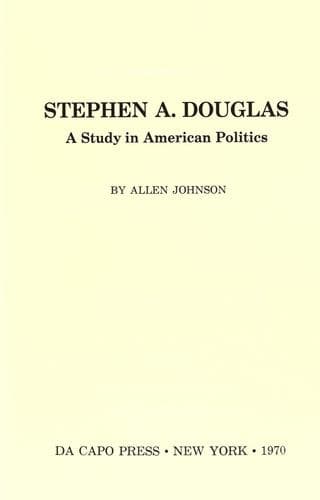
Stephen A. Douglas: A Study in American PoliticsJohnson, Allen
History
Stephen A. Douglas: A Study in American Politics
Johnson, Allen
Douglas, Stephen A. (Stephen Arnold), 1813-1861
Between these extremes were grouped the followers of Senator Cass of
Michigan, who was perhaps the most conspicuous candidate for the
Democratic nomination. In his famous Nicholson letter of December 24,
1847, he questioned both the expediency and constitutionality of the
Wilmot Proviso. It seemed to him wiser to confine the authority of the
general government to the erection of proper governments for the new
countries, leaving the inhabitants meantime to regulate their internal
concerns in their own way. In all probability neither California nor
New Mexico would be adapted to slave labor, because of physical and
climatic conditions. Dickinson of New York carried this doctrine,
which was promptly dubbed "Squatter Sovereignty," to still greater
lengths. Not only by constitutional right, but by "inherent," "innate"
sovereignty, were the people of the Territories vested with the power
to determine their own concerns.
Beside these well-defined groups there were others which professed no
doctrines and no policies. Probably the rank and file of the party
were content to drift: to be non committal was safer than to be
doctrinaire; besides, it cost less effort. Such was the plight of the
Democratic party on the eve of a presidential election. If harmony was
to proceed out of this diversity, the process must needs be
accelerated.
The fate of Oregon had been a hard one. Without a territorial
government through no fault of their own, the settlers had been
repeatedly visited by calamities which the prompt action of Congress
might have averted.[247] The Senate had failed to act on one
territorial bill; twice it had rejected bills which had passed the
House, and the only excuse for delay was the question of slavery,
which everybody admitted could never exist in Oregon. On January 10,
1848, for the fourth time, Douglas presented a bill to provide a
territorial government for Oregon;[248] but before he could urge its
consideration, he was summoned to the bed-side of his father-in-law.
His absence left a dead-lock in the Committee on Territories:
Democrats and Whigs could not agree on the clause in the bill which
prohibited slavery in Oregon. What was the true inwardness of this
unwillingness to prohibit slavery where it could never go?
The Senate seemed apathetic; but its apathy was more feigned than
real. There was, indeed, great interest in the bill, but equally great
reluctance to act upon it. What the South feared was not that Oregon
would be free soil,--that was conceded,--but that an unfavorable
precedent would be established. Were it conceded that Congress might
exclude slavery from Oregon, a similar power could not be denied
Congress in legislating for the newly acquired Territories where
slavery was possible.[249]
Public-domain text, read in full here on John Shaqi.
Reviews
Reviews
No reviews yet
Be the first to share your thoughts on this work.
Elsewhere in the archive
Join the Discussion
Join the discussion
Sign in to leave a comment or review.
Sign InorCreate an account