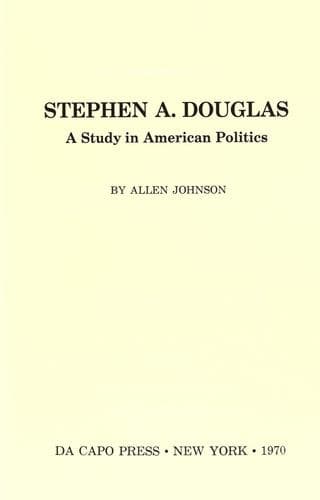
Stephen A. Douglas: A Study in American PoliticsJohnson, Allen
History
Stephen A. Douglas: A Study in American Politics
Johnson, Allen
Douglas, Stephen A. (Stephen Arnold), 1813-1861
As a last resort, a select committee was appointed, of which Senator
Clayton became chairman. Within a week, a compromise was reported
which embraced not only Oregon, but California and New Mexico as well.
The laws of the provisional government of Oregon were to stand until
the new legislature should alter them, while the legislatures of the
prospective Territories of California and New Mexico were forbidden to
make laws touching slavery. The question whether, under existing laws,
slaves might or might not be carried into these two Territories, was
left to the courts with right of appeal to the Supreme Court of the
United States.[250] The Senate accepted this compromise after a
prolonged debate, but the House laid it on the table without so much
as permitting it to be read.[251]
Douglas returned in time to give his vote for the Clayton
compromise,[252] but when this laborious effort to adjust controverted
matters failed, he again pressed his original bill.[253] Hoping to
make this more palatable, he suggested an amendment to the
objectionable prohibitory clause: "inasmuch as the said territory is
north of the parallel of 36 deg. 30' of north latitude, usually known as
the Missouri Compromise." It was the wish of his committee, he told
the Senate, that "no Senator's vote on the bill should be understood
as committing him on the great question."[254] In other words, he
invited the Senate to act without creating a precedent; to extend the
Missouri Compromise line without raising troublesome constitutional
questions in the rest of the public domain; to legislate for a special
case on the basis of an old agreement, without predicating anything
about the future. When this amendment came to vote, only Douglas and
Bright supported it.[255]
Douglas then proposed to extend the Missouri Compromised line to the
Pacific, by an amendment which declared the old agreement "revived ...
and in full force and binding for the future organization of the
Territories of the United States, in the same sense and with the same
understanding with which it was originally adopted."[256] This was
President Polk's solution of the question. It commended itself to
Douglas less on grounds of equity than of expediency. It was a
compromise which then cost him no sacrifice of principle; but though
the Senate agreed to the proposal, the House would have none of
it.[257] In the end, after an exhausting session, the Senate gave
way,[258] and the Territory of Oregon was organized with the
restrictive clause borrowed from the Ordinance of 1787. All this
turmoil had effected nothing except ill-feeling, for the final act was
identical with the bill which Douglas had originally introduced in the
House.
Public-domain text, read in full here on John Shaqi.
Reviews
Reviews
No reviews yet
Be the first to share your thoughts on this work.
Elsewhere in the archive
Join the Discussion
Join the discussion
Sign in to leave a comment or review.
Sign InorCreate an account