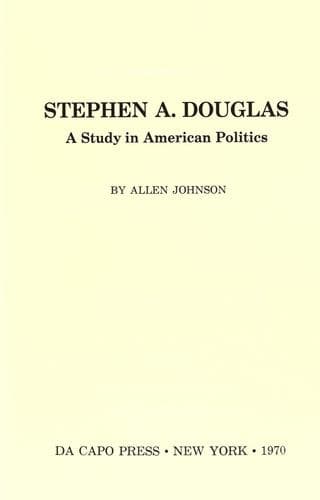
Stephen A. Douglas: A Study in American PoliticsJohnson, Allen
History
Stephen A. Douglas: A Study in American Politics
Johnson, Allen
Douglas, Stephen A. (Stephen Arnold), 1813-1861
Curiosity was excited to know what the moribund administration of the
discredited Polk would do. Douglas shared this inquisitiveness. He had
parted with the President in August rather angrily, owing to a fancied
grievance. On his return he called at the White House and apologized
handsomely for his "imprudent language."[261] The President was more
than glad to patch up the quarrel, for he could ill afford now, in
these waning hours of his administration, to part company with one
whom he regarded as "an ardent and active political supporter and
friend." Cordial relations resumed, Polk read to Douglas
confidentially such portions of his forthcoming message as related to
the tariff, the veto power, and the establishment of territorial
governments in California and New Mexico. In the spirit of compromise
he was still willing to approve an extension of the Missouri
Compromise line through our new possessions. Should this prove
unacceptable, he would give his consent to a bill which would leave
the vexing question of slavery in the new Territories to the
judiciary, as Clayton had proposed. Douglas was now thoroughly
deferential. He gratified the President by giving the message his
unqualified approval.[262]
However, by the time Congress met, Douglas had made out his own
programme; and it differed in one respect from anything that the
President, or for that matter anyone else, had suggested. He proposed
to admit both New Mexico and California; _i.e._ all of the territory
acquired from Mexico, into the Union _as a State_. Some years later,
Douglas said that he had introduced his California bill with the
approval of the President;[263] but in this his memory was surely at
fault. The full credit for this innovation belongs to Douglas.[264] He
justified the departure from precedent in this instance, on the score
of California's astounding growth in population. Besides, a
territorial bill could hardly pass in this short session, "for reasons
which may be apparent to all of us." Three bills had already been
rejected.[265]
Now while California had rapidly increased in population, there were
probably not more than twenty-six thousand souls within its borders,
and of these more than a third were foreigners.[266] One would
naturally suppose that a period of territorial tutelage would have
been peculiarly fitting for this distant possession. Obviously,
Douglas did not disclose his full thought. What he really proposed,
was to avoid raising the spectre of slavery again. If the people of
California could skip the period of their political minority and leap
into their majority, they might then create their own institutions: no
one could gainsay this right, when once California should be a
"sovereign State." This was an application of squatter sovereignty at
which Calhoun, least of all, could mock.
Public-domain text, read in full here on John Shaqi.
Reviews
Reviews
No reviews yet
Be the first to share your thoughts on this work.
Elsewhere in the archive
Join the Discussion
Join the discussion
Sign in to leave a comment or review.
Sign InorCreate an account