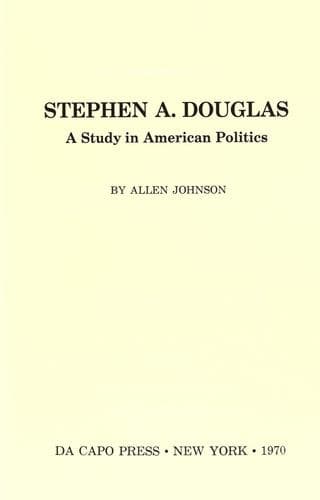
Stephen A. Douglas: A Study in American PoliticsJohnson, Allen
History
Stephen A. Douglas: A Study in American Politics
Johnson, Allen
Douglas, Stephen A. (Stephen Arnold), 1813-1861
The President and his cabinet were taken by surprise. Frequent
consultations were held. Douglas was repeatedly closeted with the
President. All the members of the cabinet agreed that the plan of
leaving the slavery question to the people of the new State was
ingenious; but many objections were raised to a single State. In
repeated interviews, Polk urged Douglas to draft a separate bill for
New Mexico; but Douglas was obdurate.[267]
To Douglas's chagrin, the California bill was not referred to his
committee, but to the Committee on the Judiciary. Perhaps this course
was in accord with precedent, but it was noted that four out of the
five members of this committee were Southerners, and that the vote to
refer was a sectional one.[268] An adverse report was therefore to be
expected. Signs were not wanting that if the people of the new
province were left to work out their own salvation, they would exclude
slavery.[269] The South was acutely sensitive to such signs. Nothing
of this bias, however, appeared in the report of the committee. With
great cleverness and circumspection they chose another mode of attack.
The committee professed to discover in the bill a radical departure
from traditional policy. When had Congress ever created a State out of
"an unorganized body of people having no constitution, or laws, or
legitimate bond of union?" California was to be a "sovereign State,"
yet the bill provided that Congress should interpose its authority to
form new States out of it, and to prescribe rules for elections to a
constitutional convention. What sort of sovereignty was this?
Moreover, since Texas claimed a part of New Mexico, endless
litigations would follow. In the judgment of the committee, it would
be far wiser to organize the usual territorial governments for
California and New Mexico.[270]
To these sensible objections, Douglas replied ineffectively. The
question of sovereignty, he thought, did not depend upon the size of a
State: without doing violence to the sovereignty of California,
Congress could surely carve new States out of its territory; but if
there were doubts on this point, he would move to add the saving
clause, "with the consent of the State." He suggested no expedient for
the other obstacles in the way of State sovereignty. As for
precedents, there were the first three States admitted into the
Union,--Kentucky, Vermont, and Tennessee,--none of which had any
organized government recognized by Congress.[271] They never furnished
their constitutions to Congress for inspection. Here Douglas hit wide
of the mark. No one had contended that a State must present a written
constitution before being recognized, but only that the people must
have some form of political organization, before they could be treated
as constituting a State in a constitutional sense.[272]
Public-domain text, read in full here on John Shaqi.
Reviews
Reviews
No reviews yet
Be the first to share your thoughts on this work.
Elsewhere in the archive
Join the Discussion
Join the discussion
Sign in to leave a comment or review.
Sign InorCreate an account