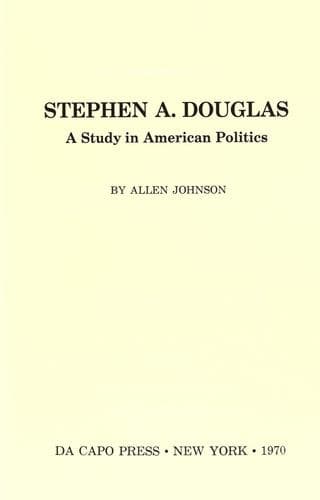
Stephen A. Douglas: A Study in American PoliticsJohnson, Allen
History
Stephen A. Douglas: A Study in American Politics
Johnson, Allen
Douglas, Stephen A. (Stephen Arnold), 1813-1861
At the same time, halting as this defense was, Douglas gave ample
proof of his disinterestedness in advocating a State government for
California. "I think, Sir," he said, "that the only issue now
presented, is whether you will admit California as a State, or whether
you will leave it without government, exposed to all the horrors of
anarchy and violence. I have no hope of a Territorial government this
session. No man is more willing to adopt such a form of government
than I would be; no man would work with more energy and assiduity to
accomplish that object at this session than I would."[273] Indeed, so
far from questioning his motives, the members of the Judiciary
Committee quite overwhelmed Douglas by their extreme deference.[274]
Senator Butler, the chairman, assured him that the committee was
disposed to treat the bill with all the respect due to its author; for
his own part, he had always intended to show marked respect to the
Senator from Illinois.[275] Douglas responded somewhat grimly that he
was quite at a loss to understand "why these assurances came so thick
on this point."
Most men would have accepted the situation as thoroughly hopeless; but
Douglas was nothing if not persistent. In quick succession he framed
two more bills, one of which provided for a division of California and
for the admission of the western part as a State;[276] and then when
this failed to win support, he reverted to Folk's suggestion--the
admission of New Mexico and California as two States.[277] But the
Senate evinced no enthusiasm for this patch-work legislation.[278]
The difficulty of legislating for California was increased by the
disaffection of the Southern wing of the Democratic party. Calhoun was
suspected of fomenting a conspiracy to break up the Union.[279] Yet in
all probability he contemplated only the formation of a distinctly
Southern party based on common economic and political interests.[280]
He not only failed in this, because Southern Whigs were not yet ready
to break with their Northern associates; but he barely avoided
breaking up the solidarity of Southern Democrats, and he made it
increasingly difficult for Northern and Southern Democrats to act
together in matters which did not touch the peculiar institution of
the South.[281] Thenceforth, harmonious party action was possible only
through a deference of Northern Democrats to Southern, which was
perpetually misinterpreted by their opponents.
Public-domain text, read in full here on John Shaqi.
Reviews
Reviews
No reviews yet
Be the first to share your thoughts on this work.
Elsewhere in the archive
Join the Discussion
Join the discussion
Sign in to leave a comment or review.
Sign InorCreate an account