Stone's River: The Turning-Point of the Civil War — John Shaqi
Stone's River: The Turning-Point of the Civil WarVance, Wilson J.
History
Stone's River: The Turning-Point of the Civil War
Vance, Wilson J.
Stones River, Battle of, Murfreesboro, Tenn., 1862-1863
Produced by The Online Distributed Proofreading Team at
http://www.pgdp.net (This file was produced from images
generously made available by The Internet Archive/American
Libraries.)
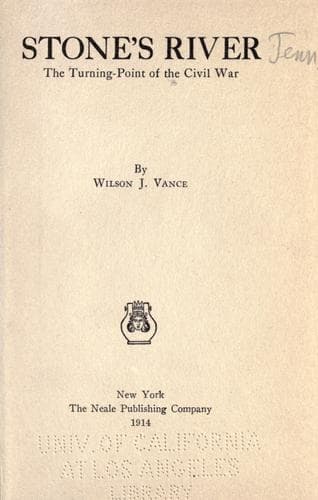
STONE'S RIVER
The Turning-Point of the Civil War
By
WILSON J. VANCE
New York
The Neale Publishing Company
1914
(Copyright, 1914)
By The Neale Publishing Company
TO MY WIFE
ORDER OF CONTENTS
Page
Preface 7
Introduction 9
Chapter
I North and South in 1862 12
II Foreign Relations in 1862 21
III The Armies and Their Leaders 31
IV The First Day's Battle 44
V The Night and the Next Day 55
VI The Second of January, 1863 59
VII What Might Have Been,--and What Was 63
Appendix 67
STONE'S RIVER
PREFACE
While many authorities were consulted in the preparation of this work,
particular acknowledgment is due John Formby's "The American Civil War,"
wherein was suggested the proposition that is here laid down and expanded;
to Van Horne's "History of the Army of the Cumberland," which gives the
campaigns of that organization in minute detail; to several of the papers
and books of Charles Francis Adams,--documents that deal principally with
the diplomacy of the Civil War, and to the published and spoken words of
the author's father,--the late Wilson Vance,--orderly to the brigade
commander whose charge against orders turned defeat into victory in the
battle here described. The book grows out of a short article published in
the Newark _Sunday Call_, December 29, 1912,--an article that attracted
considerable attention, rather because of the novelty of the theory
advanced than because of other merit.
It may be permissible to add that few persons,--comparatively,--conceive
the bearing on the outcome of the Civil War, of the campaigns and battles
that took place beyond the Alleghanies. There is more than one pretentious
history, which would lead a reader to suppose that all of the events of
importance took place upon the Atlantic seaboard. It does not diminish in
the least either the merit or the renown of the armies that measured their
strength in that confined arena to suggest that the movements that
resulted in the transfer of the control over hundreds of thousands of
square miles of territory,--territory that teemed with the fruits of the
earth,--was, taken in connection with the naval blockade, a very
considerable factor in the wearing down and final collapse of the Southern
Confederacy.
WILSON J. VANCE
NEWARK, N. J., JULY 14, 1914.
INTRODUCTION
Public-domain text, read in full here on John Shaqi.
Reviews
Reviews
No reviews yet
Be the first to share your thoughts on this work.
Join the Discussion
Join the discussion
Sign in to leave a comment or review.
Sign InorCreate an account