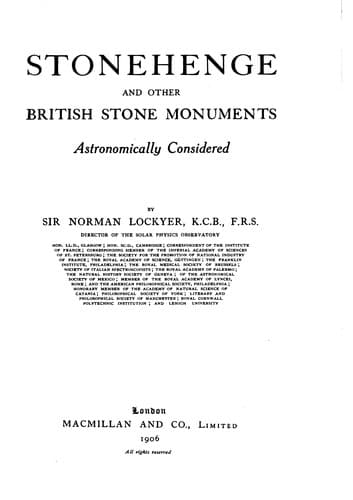
Stonehenge and Other British Stone Monuments Astronomically ConsideredLockyer, Norman, Sir
History
Stonehenge and Other British Stone Monuments Astronomically Considered
Lockyer, Norman, Sir
Druids and Druidism; Great Britain -- Antiquities; Stonehenge (England); Sun worship; Temples
Other arguments may be founded upon linguistic considerations. Prof. J.
Morris Jones[99] finds that the syntax of Welsh and Irish differs from
that of other Aryan languages in many important respects, _e.g._ the
verb is put first in every simple sentence. Prof. Rhys had suggested
that these differences represented the persistence in Welsh and Irish of
the syntax of a pre-Aryan dialect, and as the anthropologists hold that
the pre-Aryan population of these islands came from North Africa, it
seemed to Prof. Jones that that was the obvious place to look for the
origin of these syntactical peculiarities. He finds the similarities
between Old Egyptian and neo-Celtic syntax to be astonishing; he shows
that practically all the peculiarities of Welsh and Irish syntax are
found in the Hamitic languages.
This conclusion practically implies that the bulk of the population of
these islands, before the arrival of the Celts, spoke dialects allied to
those of North Africa. The syntactical peculiarities must have
represented the habits of thought of the people, which survived in the
Celtic vocabulary imposed upon them.
These conclusions were not known to me when I began to see the necessity
of separating the cult of the June from that of the May year, and the
identity of the conclusions drawn from astronomical and linguistic data
is to me very striking and also suggests further special inquiries.
It is also worth while to state that the Semites, including the Hebrews
and Phœnicians, did not burn their dead. Finally, I may quote a remark
made by General Pitt-Rivers in the paper already referred to:--“If we do
not accept one old civilization as the origin of the various practices,
then we must assume accidental origins in each country.”
[83] Wood-Martin, p. 265.
[84] _Dolmens of Ireland_, ii., p. 696.
[85] _Ibid._, ii., p. 580.
[86] _Ibid._, p. 772.
[87] _Journal Eth. Soc._, N.S., i., 64.
[88] _Journ. Eth. Soc._, N.S. i., 64.
[89] _The Mediterranean Races_, p. 4.
[90] _The Oldest Civilisation of Greece_, p. 105.
[91] This I gather from the plan prepared by Lieut. Glascott, R.N., who
apparently accompanied Mr. Layard. He indicates the true north point
with a sailor’s precision in such matters. (See p. 305).
[92] _Evolution of the Aryan_, Translation by Drucker, § 32.
[93] The prevalence of solstitial customs in Sardinia and Corsica, with
apparently no trace of the May year, tends to support this view, which
is also strengthened by the fact that the solstitial customs in Morocco
are very similar to those we read of in Britain: the May year is
unnoticed, and there is a second feast at Easter (March 16th). See
Westermarck in _Folk-lore_, vol. xxi., p. 27.
[94] And if thou wilt make me an altar of stone, thou shalt not build it
of hewn stone: for if thou lift up thy tool upon it, thou hast polluted
it.--Exodus, xx., 25.
Public-domain text, read in full here on John Shaqi.
Reviews
Reviews
No reviews yet
Be the first to share your thoughts on this work.
Elsewhere in the archive
Join the Discussion
Join the discussion
Sign in to leave a comment or review.
Sign InorCreate an account