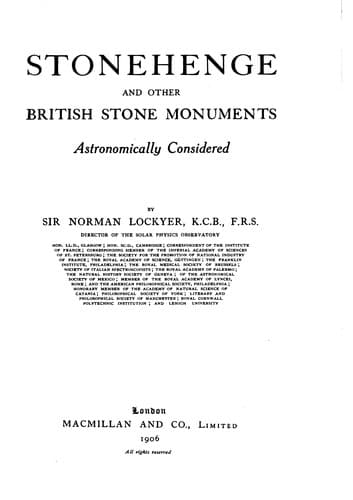
Stonehenge and Other British Stone Monuments Astronomically ConsideredLockyer, Norman, Sir
History
Stonehenge and Other British Stone Monuments Astronomically Considered
Lockyer, Norman, Sir
Druids and Druidism; Great Britain -- Antiquities; Stonehenge (England); Sun worship; Temples
[95] And Jacob rose up early in the morning, and took the stone that he
had put for his pillows, and set it up for a pillar, and poured oil upon
the top of it.
And this stone, which I have set for a pillar, shall be God’s house; and
of all that thou shalt give me I will surely give the tenth unto
thee.--Genesis, xxviii., 18, 22.
[96] Herodotus, iii., 8, refers to an Arabian rite in which seven stones
are smeared with blood among peoples whose only gods were Dionysos and
Urania, whom they called Orotalt and Alilat.
[97] Sayce, _Babylonians and Assyrians_, p. 234.
[98] _Nili op. quaedam_ (Paris, 1639), pp. 28, 117, quoted by Robertson
Smith, p. 151.
[99] “Pre-Aryan Syntax in Insular Celtic,” in the _Welsh People_, by
Rhys and Brynmor-Jones, pp. 617-641.
CHAPTER XXIII
THE SIMILARITY OF THE SEMITIC AND BRITISH WORSHIPS
I propose in this chapter to bring into juxtaposition the various
British and Semitic-Egyptian practices which we have so far considered.
I confess I am amazed at the similarities we have come across in the
first cast of the net; we have found so much that is common to both
worships in connection with all the points we considered separately. I
will, for convenience, deal with the various points seriatim.
1. The cult of sacred stones or cairns.
The only objection which, so far as I can see, may be raised to these
practices being absolutely common is the idea among many British
archæologists that the cairns, in which term I include chambered barrows
or dolmens and their skeletons, the cromlechs and stone passages, were
set up for burial and not for worship. This idea has arisen because some
of them have been used for burials. But I cannot accept this argument,
because since the burials might have taken place at any time subsequent
to their erection they prove nothing as to the reason of the erection;
and further, if these chambered cairns were meant for burials, there
should be burials in all of them, and yet there are none in the most
majestic of them all, Maeshowe.
Let us consider a few facts in relation to the Semitic use of cairns
referred to on p. 244.
That the cromlechs found both in Britain and Syria--there are 780 in
Ireland and 700 in Moab--are the remains of chambered cairns is pretty
clear from the evidence brought forward by Borlase.[100]
Mr. John Bell, of Dundalk, disinterred over sixty cromlechs from cairns
in Ulster. All dolmens were covered by tumuli according to Mr. Bell and
Mr. Lukis. Monuments called cairns in the earliest Ordnance Survey have
been marked dolmens in subsequent surveys (_e.g._ Townland of Leana in
Clare) because the earth covering the stones had disappeared in the
meantime.
Among the evidences of natural and artificial caves preceding cairns
which replaced them are the twenty-four caves which have been explored
in France (_op. cit._, p. 568).[101]
Public-domain text, read in full here on John Shaqi.
Reviews
Reviews
No reviews yet
Be the first to share your thoughts on this work.
Elsewhere in the archive
Join the Discussion
Join the discussion
Sign in to leave a comment or review.
Sign InorCreate an account