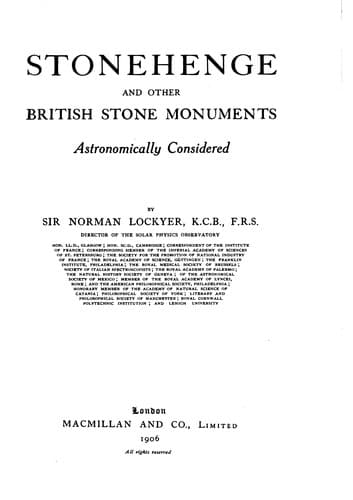
Stonehenge and Other British Stone Monuments Astronomically ConsideredLockyer, Norman, Sir
History
Stonehenge and Other British Stone Monuments Astronomically Considered
Lockyer, Norman, Sir
Druids and Druidism; Great Britain -- Antiquities; Stonehenge (England); Sun worship; Temples
Here we find beyond all question that the festival times were the same
to begin with. May is the chief month both in West Asia and West Europe.
It was not till a subsequent time that June and December were added in
Egypt and Britain, and April and September among the Jews.
6. The characteristics of the festivals.
Here again is precise agreement. The list I gave on p. 205 of what can
be gathered from British folklore is identical with the statements as to
Semitic practices which I quoted from Robertson Smith in the last
chapter.
7. The worship in high places.
Absolute identity; and from this we can gather that the ancient
condition of the high places wherever selected for temple worship was as
treeless as it is now; otherwise the observations of sun- and star-rise
and -set would be greatly interfered with.
Of course, there may have been “groves” associated with, but away from,
sanctuaries in both Semitic and British areas: but it is not impossible
that much which has been written on this subject with regard to Britain
and the “Druids” may have been suggested in part by the erroneous
translation of Asherah to which I have referred. It has also been stated
that an early transcriber who, in error, substituted lucus for locus may
also be held partly responsible, even if lucus does not mean a clearing
in a grove, as some maintain.
8. The god or gods worshipped.
The year-gods in Babylonia and Egypt respectively were Baal and Thoth.
It is worth while to inquire whether either name has made its appearance
as a loan-word in the traditions of Western Europe.
About Baal there can be no question as to the coincidence, whether
accidental, as some philologists affirm, or not.
We find Bel or Baal common to the two areas. Mr. Borlase informs us
(_op. cit._, p. 1164) that in Western Europe Bel, Beal, Balor, Balder,
and Phol, Fal, Fáil are the equivalents of the Semitic Baal. Balus,
indeed, is named as the first king of Orkney. A May worship is connected
with all the above. Beltaine and many variants describe the fires
lighted at the festival, and it is worthy of note that although this
fire worship has been extended to the solstitial ceremonials in June,
the name Baltaine has never been applied to it at that time except by
writers who think that the term “midsummer” may be applied
indiscriminately to the beginning of May and the end of June.
I next deal with the Egyptian year-god Thoth. In Greece he became
Hermes, among the Romans Mercury. In this connection I can most usefully
refer to Rhys’s Hibbert Lectures and his chapter on the Gaulish
Pantheon. He tells us (p. 5) that “Mercury is the god with whom the
monuments lead one to begin.” There is also mention of a god Toutates or
Teutates, and a Toutius, who might have been a public official (? priest
of Toutates). Only Celtic or other later origins of the words are
suggested; it is not said whether the possible Egyptian root has been
considered.
Public-domain text, read in full here on John Shaqi.
Reviews
Reviews
No reviews yet
Be the first to share your thoughts on this work.
Elsewhere in the archive
Join the Discussion
Join the discussion
Sign in to leave a comment or review.
Sign InorCreate an account