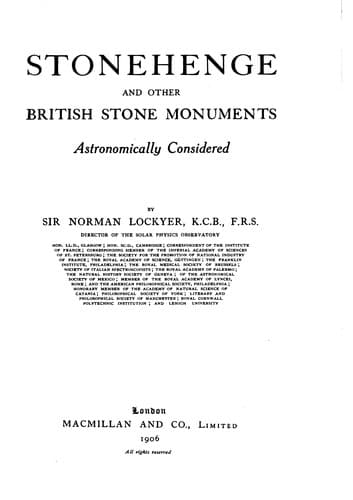
Stonehenge and Other British Stone Monuments Astronomically ConsideredLockyer, Norman, Sir
History
Stonehenge and Other British Stone Monuments Astronomically Considered
Lockyer, Norman, Sir
Druids and Druidism; Great Britain -- Antiquities; Stonehenge (England); Sun worship; Temples
“Formerly the menhir was beplastered with oil and honey and wax, and
this anointing of the stones was condemned by the bishops. In certain
places the local clergy succeeded in diverting the practice to the
Churches. There are still some in Lower Brittany whose exterior walls
are strung with wax lines arranged in festoons and patterns.
“In some places childless women still rub themselves against menhirs,
expecting thereby to be cured of barrenness, but in others, instead,
they rub themselves against stone images of saints.”
When I visited the Cave of Elephanta in 1871 I was told that the barren
women of Bombay visit the cave once a year and anoint the standing stone
in the chief chamber. In Egypt they still rub their bodies on the
Colossi.
2. Sacred fires.
Among the Semites the sacrificial fat was burned on the altar. And we
have seen that “this could be done without any fundamental modification
of the old type of sacred stone or altar pillar, simply by making a
hollow on the top to receive the grease.”[107]
[Illustration: FIG. 49.--Cresset-stone, Lewannick. From Baring-Gould’s
_Strange Survivals_.]
Baring-Gould[108] has written on the question of sacrificial and sacred
fires in ancient times in Britain, and points out that there still
remain in some of our churches (in Cornwall, York and Dorset) the
contrivances--now called cresset-stones--used. They are blocks of stone
with cups hollowed out precisely as described by Robertson Smith. Some
are placed in lamp-niches furnished with flues. On these he remarks (p.
122):--
“Now although these lamps and cressets had their religious
signification, yet this religious signification was an afterthought. The
origin of them lay in the necessity of there being in every place a
central light, from which light could at any time be borrowed.”
3. The cult of the sacred tree.
I have shown that the sacred trees in Britain, whether rowan, thorn or
mistletoe, were at their best at the times of the festivals at which
they were chiefly worshipped. Mrs. J. H. Philpot, in her valuable book
on “the sacred tree,” gives us the names of some used in different
countries; it would be interesting to inquire whether the same
consideration applies to them in the Semitic and other areas.
There seems to be no doubt that the Semitic Asherah was the precursor of
the British Maypole, even to its dressing of many coloured ribands, and
from the Maypole customs we may infer something of the Semitic practices
which have not come down to us. Even “Jack o’ the Green” may eventually
be traced to Al-Khidr (p. 29) of the old May festivals.
4. The cult of the sacred well.
Here we find only trifling differences. The chief one is the use of
pins in Britain. If we knew more about the Asherah with its hooks this
difference might disappear.
It has been pointed out by several authors that the worship of wells and
water would be most likely to arise in a dry and thirsty land.
5. The time of the chief festivals.
Public-domain text, read in full here on John Shaqi.
Reviews
Reviews
No reviews yet
Be the first to share your thoughts on this work.
Elsewhere in the archive
Join the Discussion
Join the discussion
Sign in to leave a comment or review.
Sign InorCreate an account