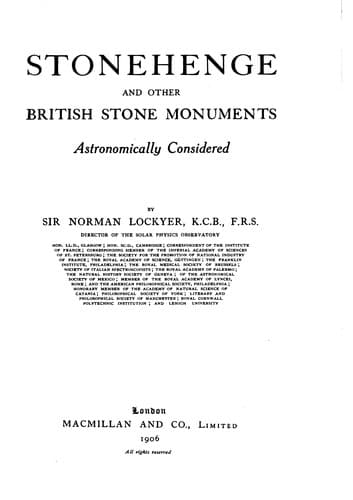
Stonehenge and Other British Stone Monuments Astronomically ConsideredLockyer, Norman, Sir
History
Stonehenge and Other British Stone Monuments Astronomically Considered
Lockyer, Norman, Sir
Druids and Druidism; Great Britain -- Antiquities; Stonehenge (England); Sun worship; Temples
(1) Observatories, _i.e._, circles in the first place; next something to
mark the sight-lines to the clock-star for night work, to the rising or
setting of the warning stars, and to the places of sunrise and sunset at
the chief festivals. This something, we have learned, might be another
circle, a standing stone, a dolmen, a cove, or a holed stone.
A study of the sight-lines shows us that these collimation marks, as we
may call them, were of set purpose, generally placed some distance away
from the circles, so far that they would require to be illuminated in
some way for the night and dawn observations. When there was no wind,
one or more hollows in a stone, whether a menhir or a quoit, might have
held grease to feed a wick or a pine-wood torch. But in a wind some
shelter would be necessary, and the light might have been used in a
cromlech or allée couverte. Stones have been found with such cups, and
débris of fires have been found in cromlechs.
It must not be forgotten that here there was no oil as in the Semitic
countries whence, as we have seen, the immigrants came; and it was not a
question of a light on the sight-line alone. If wood were used, it must
have been kept dry for use, and whether wood or animal fat were employed
the most practical and convenient way of lighting up would have been to
keep a fire ever burning in some sheltered place.
(2) Dwellings, which would be cromlechs or many-chambered barrows,
according to the number of astronomer-priests at the station. These
dwellings would require to be protected against the invasions of the
local fauna, very different from what it is now, and for this a small,
and on that account easily blocked, entrance would be an essential.
These dwellings would naturally suggest themselves as the shelter place
for the ever-burning fire or the supply of dry wood. Tradition points
with no uncertain sound to the former existence of life and light in
these “hollow hills.” Mr. MacRitchie’s book[127] contains a mine of most
valuable and interesting information on this subject.
(3) A water supply for drinking and bathing, which might be a spring,
river or lake, according to the locality.
Given a supply of food we have now provided for the shelter and
protection of the astronomer and the man.
Public-domain text, read in full here on John Shaqi.
Reviews
Reviews
No reviews yet
Be the first to share your thoughts on this work.
Elsewhere in the archive
Join the Discussion
Join the discussion
Sign in to leave a comment or review.
Sign InorCreate an account