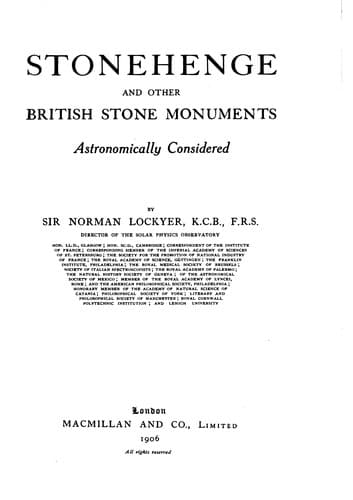
Stonehenge and Other British Stone Monuments Astronomically ConsideredLockyer, Norman, Sir
History
Stonehenge and Other British Stone Monuments Astronomically Considered
Lockyer, Norman, Sir
Druids and Druidism; Great Britain -- Antiquities; Stonehenge (England); Sun worship; Temples
But the man who brought this new astronomical knowledge was, before he
came, astrologer and magician as well, and, further, he was a priest;
hence on account of his knowledge of the seasons, he could not only help
the aboriginal tiller of the soil as he had never been helped before, by
his knowledge; but he could appeal in the strongest way to his
superstitious fears and feelings, by his function as the chief
sacrificer and guardian of the sacrificial altars and fires. Hence it
was that everything relating to the three different classes of things to
which I have referred was regarded as very holy because they were
closely associated with the astronomer-priests, on whom the early
peoples depended for guidance in all things, not only of economic, but
of religious, medical and superstitious value.
The perforated stones were regarded as sacred, so that passing through
them was supposed to cure disease. Whether men and women, or children
only, passed through the hole depended upon its size. But a hole large
enough for a head to be inserted was good for head complaints.
The wells, rivers, and lakes used by the priests were, as holy places,
also invested with curative properties, and offerings of garments
(skins?), and pins to fasten them on, as well as bread and wine and
cheese, were made at these places to the priests.
The fact that the tree on which the garment was hung was either a rowan
or a thorn shows that these offerings commenced as early as the
May-November worship.
The holed stones, besides being curative, were in long after years,
when marriage had been instituted, used for the interchange of marriage
vows by clasping hands through the opening.
The cups for the light would also be sacred objects; and many of them
have been since used for holy water.
The cursus at Stonehenge and the avenues on Dartmoor may be regarded as
evidences that sacred processions formed part of the ceremonial on the
holy days, but sacrifices and sacred ceremonials were not alone in
question; many authors have told us that feasts, games and races were
not forgotten. This, so far as racing is concerned, is proved, I think,
by the facts that the cursus at Stonehenge is 10,000 feet long and 350
feet broad, that it occupies a valley between two hills, thus permitting
of the presence of thousands of spectators, and that our horses are
still decked in gaudy trappings on May Day.
Public-domain text, read in full here on John Shaqi.
Reviews
Reviews
No reviews yet
Be the first to share your thoughts on this work.
Elsewhere in the archive
Join the Discussion
Join the discussion
Sign in to leave a comment or review.
Sign InorCreate an account