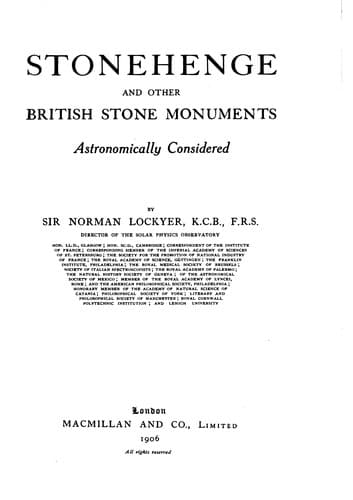
Stonehenge and Other British Stone Monuments Astronomically ConsideredLockyer, Norman, Sir
History
Stonehenge and Other British Stone Monuments Astronomically Considered
Lockyer, Norman, Sir
Druids and Druidism; Great Britain -- Antiquities; Stonehenge (England); Sun worship; Temples
Between the years 2300 B.C. and 1600 B.C., whether we are dealing with
the same race of immigrants or not, we pass from unhewn to worked
stones. The method of this working and its results have been admirably
shown to us by Prof. Gowland’s explorations at Stonehenge.
From the tables, given in Chap. XXVIII, it can be seen that, so far as
the present evidence goes, there was a pretty definite time--about 2300
B.C.--of beginning the astronomical work at the chief monuments;
Cornwall came first, Dartmoor was next.
Almost as marked as the simultaneous beginning are the dates of ending
the observations, if we may judge of the time of ending by the fact that
the precessional changes in the star places were no longer marked by the
marking out of new sight lines.
The clock-star work was the first to go, about 1500 B.C. The May-warning
stars followed pretty quickly.
We may say, then, that we have full evidence of astronomical activity of
all kinds at the circles for a period of some 700 years.
What prevented its continuance on the old lines? It may have been that
the invention of some other method of telling time by night had rendered
the old methods of observation, and therefore the apparatus to carry
them on, no longer necessary.
On the other hand, it may have been that some new race, less
astronomically inclined, had swept over the land.
I am inclined to take the former view. It is quite certain that for the
clock-stars other observations besides those on the horizon would soon
have suggested themselves for determining the lapse of time during the
night. The old, high, bleak, treeless moorlands might then in process of
time have been gradually forsaken, and life may have gone on in valleys
and even in sheltered woods, except on the chief festivals. When this
was so astronomy and superstition would give way to politics and other
new human interests, and the priests would become in a wider sense the
leaders and the teachers of the more highly organised community.
It is clear that in later days as at the commencement they were still
ahead in the knowledge of the time. “Hi terrae mundique magnitudinem et
formam, motus coeli ac siderum, ac quod dii velunt sciere profitentur”
is Pomponius Mela’s statement concerning them.[130] From 1500 B.C. to
Cæsar’s time is a long interval, and yet the astronomical skill of the
so-called Druids, who beyond all question were the descendants of our
astronomical-priests, was then a matter of common repute. Cæsar’s
account of the Druids in Gaul (_Bello Gallico_, vi. c. 13, 14, 15) is
extremely interesting because it indicates, I think, that the Druid
culture had not passed through Gaul and had therefore been waterborne to
Britain, whither the Gauls therefore went to study it.[131]
Public-domain text, read in full here on John Shaqi.
Reviews
Reviews
No reviews yet
Be the first to share your thoughts on this work.
Elsewhere in the archive
Join the Discussion
Join the discussion
Sign in to leave a comment or review.
Sign InorCreate an account