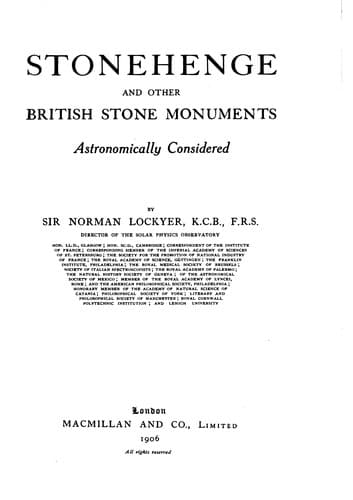
Stonehenge and Other British Stone Monuments Astronomically ConsideredLockyer, Norman, Sir
History
Stonehenge and Other British Stone Monuments Astronomically Considered
Lockyer, Norman, Sir
Druids and Druidism; Great Britain -- Antiquities; Stonehenge (England); Sun worship; Temples
Simultaneously with the non-use of the ancient stones, we may imagine
that the priests--of ever-increasing importance--no longer dwelt in
their cromlechs, but, rather, occupied such buildings as those which
remain at Chysoister, and from this date it is possible that burials may
have taken place in some of the mounds then given up as dwelling places.
As sacred places they were subsequently used for burials, as Westminster
Abbey has been; but burials were not the object of their erection.[132]
This new habit may have started the practice of cist burial by later
people in barrows thrown up for that special purpose.
I cannot close this Chapter without expressing my admiration of the
learning and acumen displayed by Dr. Borlase in his treatment of the
subject of the Druids in his _History of Cornwall_, published in 1769; I
find he has anticipated me in suggesting that the hollowed stones were
used for fires. It is clear, now that the monuments have been dated,
that the astronomical knowledge referred to by Cæsar and Pomponius Mela
was no new importation; if, therefore, the present view of ethnologists
that the Celtic intrusion took place about 1000 B.C. is correct, it is
certain the Celts brought no higher intelligence with them than was
possessed by those whom they found here; nor is this to be expected if,
as the inquiry has suggested, the latter were the representatives of the
highest civilisation of the East with which possibly the former had
never been brought into contact.
[127] _The Testimony of Tradition._
[128] _History of Human Marriage_, Chapter II.
[129] _Celtic Folklore_, ii., 654.
[130] _Pomp. Mela_, Lib. II. c. 2. I have already (p. 52) quoted Cæsar’s
testimony to the same effect.
[131] “Disciplina in Britannia reperta, atque in Galliam translata esse
existimatur.”--_C. Bell. Gall._ lib. vi. c. 13. This “discipline” also
included magic according to Pliny. “Britannia hodie eam (_i.e._ Magiam)
attonite celebrat tantis ceremoniis, ut eam Persis dedisse videri
possit” (lib. xxx. c. 1.)
[132] Bertrand and Reinach, _Les Celtes et les Gaulois dans les Vallées
du Pô et du Danube_, p. 82. Tregellis, “Stone Circles in Cornwall.”
_Trans._ Penzance Natural History and Antiquarian Society, 1893-4.
APPENDICES
I. DETAILS OF THE THEODOLITE OBSERVATIONS AT STONEHENGE
The instrument chiefly employed was a six-inch transit theodolite by
Cooke with verniers reading to 20″ in altitude and azimuth. Most of the
observations were made at two points very near the axis, which may be
designated by _a_, _b_. Station _a_ was at a distance of 61 feet to the
south-west of the centre of the temple, and _b_ 364 feet to the
north-east. The distance from the centre of Stonehenge to Salisbury
Spire being 41,981 feet, the calculated corrections for parallax at the
points of observation with reference to Salisbury Spire are:--
Station _a_ + 4′ 12″.
„ _b_ - 25′ 20″.
(1) _Relative Azimuths._--Theodolite at station _a_--
Public-domain text, read in full here on John Shaqi.
Reviews
Reviews
No reviews yet
Be the first to share your thoughts on this work.
Elsewhere in the archive
Join the Discussion
Join the discussion
Sign in to leave a comment or review.
Sign InorCreate an account