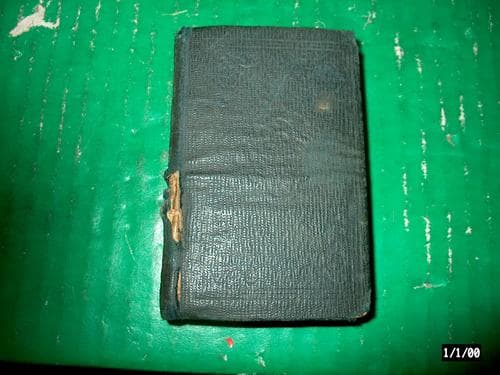
Produced by Larry B. Harrison and the Online Distributed
Proofreading Team at http://www.pgdp.net (This file was
produced from images generously made available by The
Internet Archive/American Libraries.)
STORIES
ABOUT
INDIANS.
CONCORD, N. H.
RUFUS MERRILL.
STORIES
ABOUT
INDIANS.
[Illustration]
CONCORD, N.H.:
PUBLISHED BY MERRIAM & MERRILL
1854.
[Illustration: The above picture represents Indians hunting Buffalo.]
STORIES ABOUT INDIANS.
The Indians were formerly lords of the soil we now occupy, and
obtained a subsistence principally by hunting and fishing.
They generally lived in villages, containing from fifty to five
hundred families. Their houses, called _wigwams_, were usually
constructed of poles, one end being driven into the ground, and the
other bent over so as to meet another fastened in like manner; both
being joined together at the top, and covered with the bark of trees.
Small holes were left open for windows, which were closed in bad
weather with a piece of bark. They made their fire in the centre of
the wigwam, leaving a small hole for a chimney in the top of the roof.
[Illustration: Indian Village.]
They had no chairs, but sat upon skins, or mats, spread upon the
ground, which also served them for beds. Their clothes were
principally made of the skins of animals, which in winter were sewed
together with the fur side turned inwards.
The Indians were very fond of trinkets and ornaments, and often
decorated their heads with feathers, while fine polished shells were
suspended from their ears.
A PAWNEE BRAVE.
The following anecdote is related of a Pawnee brave, or warrior, (son
of Red Knife).
At the age of twenty-one, the heroic deeds of this brave had acquired
for him in his nation the rank of the bravest of the braves. The
savage practice of torturing and burning to death their prisoners
existed in this nation. An unfortunate female of the Paduca nation,
taken in war, was destined to this horrid death.
[Illustration: Pawnee Brave.]
Just when the funeral pile was to be kindled, this young warrior,
having unnoticed prepared two fleet horses, with the necessary
provisions, sprang from his seat, liberated the victim, seized her in
his arms, placed her on one of the horses, mounted the other himself,
and made the utmost speed toward the nation and friends of the
captive! The multitude, dumb and nerveless, made no effort to rescue
their victim from her deliverer. They viewed it as the immediate act
of the Great Spirit, submitted to it without a murmur, and quietly
retired to their village.
INDIAN GRATITUDE.
Public-domain text, read in full here on John Shaqi.
Reviews
Reviews
No reviews yet
Be the first to share your thoughts on this work.
Join the Discussion
Join the discussion
Sign in to leave a comment or review.
Sign InorCreate an account