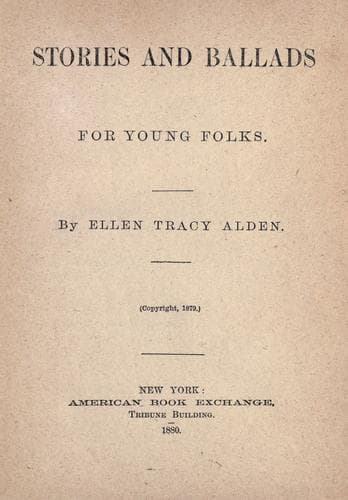
Stories and ballads for young folksAlden, Ellen Tracy
General
Stories and ballads for young folks
Alden, Ellen Tracy
Children -- Conduct of life -- Juvenile literature; Children's poetry; Children's stories; Conduct of life -- Juvenile literature
“They” are the dozen or more of lads and lasses who, in the pleasant
summer twilights, have frequently been seen, as now, gathered before the
house where the blind soldier lives. The sparrows soon learn to know that
door or window where they are welcome, and where crumbs are scattered
for them. They flock about it, fearless, chirping cheerily, and make
themselves at home there. Thus these stone steps leading up to the porch
have become a favorite resort of the youngsters of the neighborhood; for
here they may meet unmolested, and chatter and laugh to their hearts’
content; here crumbs, in the shape of stories, are now and then thrown
out for bait; and partly they may be drawn hither by the presence of
the amused listener to their random talk; tacitly understanding that to
him, who is denied the sight of their bright young faces, the sound of
their clear young voices is doubly sweet. But he is not the only one who
is entertained. Sometimes one of his older friends will join the merry
group—often the venerable Frenchman who resides across the street. It so
happens that he approaches just now, as Harry is making that time-worn
request—“a story”; and the other says, “I think that is Monsieur, coming?
Perhaps _he_ will tell us one.”
“Yes, now, grandpapa,” coaxes Marie, “tell us about Gabrielle.”
“_Bien_,” and he accepts the proffered arm-chair; “I will tell, then, the
story of Gabrielle.
“Without doubt, my dear children, some of you have heard of that event in
the history of France which is termed the Revolution? I do not speak of
those more recent troubles which have distracted my native land, but of
that memorable Revolution which blackened the closing years of the last
century—a period at which you gaze as upon a sky filled with the darkness
of clouds, and the threatening thunder, and the fierce lightning-flashes.
“Ah, my children, you are happy to be of a nation which has not that wild
and horrible dream to remember. And here I will say to you, I, that you
are truly fortunate to live in a land most free, where there is less of
oppression than in any other; where one can say what he will, do what he
will. If but he keep the laws he is secure. He may be of whatever party
he chooses. Nobody is going to harm him. He may, if so ill-disposed, say
whatever _désagréables_ he please of those who believe not as he. He will
not be obliged to fly and to take refuge among strangers, as I myself,
long time ago, for that, in company with others, I preferred a king to an
emperor, and was not sufficiently secret about it. Deserving, indeed, of
gratitude are they who, defending this beautiful country, have preserved
to it peace and freedom.
Public-domain text, read in full here on John Shaqi.
Reviews
Reviews
No reviews yet
Be the first to share your thoughts on this work.
Join the Discussion
Join the discussion
Sign in to leave a comment or review.
Sign InorCreate an account