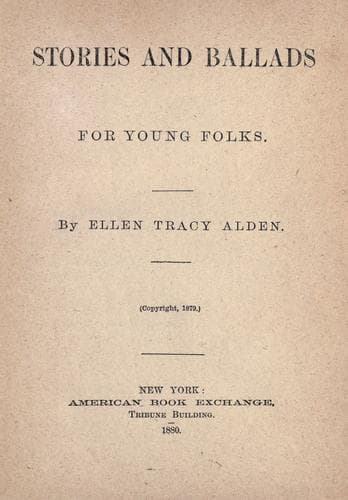
Stories and ballads for young folksAlden, Ellen Tracy
General
Stories and ballads for young folks
Alden, Ellen Tracy
Children -- Conduct of life -- Juvenile literature; Children's poetry; Children's stories; Conduct of life -- Juvenile literature
“Oh, I beg pardon! an ‘over-skirt,’ is it? So she’s a fashionable doll.
What might be her name?”
“Guess.”
“Keturah?”
“No.”
“Jerusha?”
“No.”
“Mary Ann, Sacharissa, Sophia, Clarissa, Joan, Melissa, Eloise,
Elizabeth, Jane—”
“No-o-o-o-o!”
“Victoria, Eugenia, Augusta, Paulina, Virginia, Aurelia, Geraldine,
Mollie—”
“Yes! Mollie! that’s what it is; but none of your other old—elephants.
There, you’re laughing! You knowed what it was all the time; you was only
pertendin’. You’ve seen my dolly before.”
“Where’s Katy?”
“She stayed down-stairs to pop some corn for me and you.”
“Shall we go down and see her do it?”
“Yes.”
“Very well.” And the Lieutenant, rising, manages to shift little dot up
to his shoulder. “There, now, you’re a feather on top of a barn-door.”
“You’re _not_ a barn-door!”
“What am I, then?”
“You’re my brave captain boy.” (That was in a whisper.)
“Shall I tell you what _you_ are? You’re my little angel.” And, holding
her carefully, he goes down the stairs, feeling his way, now and then,
with the remnant of an arm in his dangling right sleeve.
“I’m almost through,” cries Kate, from the kitchen, her face all
aglow with the heat. And Edith, from her lofty perch, watches the few
yellow kernels that are nearly lost sight of in the bottom of the wire
corn-popper, after a shake or two over the hot coals, suddenly—“Snap,
snap, snap!” and look! it is full to the brim with something white and
savory, which, seasoned with salt and the least bit of butter, she deals
out (with great fairness and impartiality) to herself and her “captain
boy,” after they have gone up-stairs again. By and by a thought strikes
her.
“Katy, my doll hasn’t got any apron.”
“Why, so she hasn’t. We’ll have to make her one, won’t we?” And a box of
ribbons and laces and pieces of silk is produced from somewhere, and the
two sit down on the floor near the Lieutenant’s chair, talking all the
time and planning out this wonderful apron.
“Now which of all these colors does Edie like best?” asks Kate.
“Well, I think the red’s the nicest.”
So an apron (with pockets, observe!) is soon manufactured out of a bit
of a broad scarlet sash, and braided, too, with white silk braid; and
straightway on it goes, in feverish haste (one is anxious to study the
effect, you know), over the stylish (but serene) Mademoiselle’s black
satin gown. (The effect isn’t bad.)
After due admiration from Edith, some other diversion is in order, and a
book of engravings is brought for inspection. As the leaves are turned
for her she glances for an instant at one picture after another, giving
the word to proceed; but they finally come to something over which she
pores a long while—so long that Kate is passing to the next without
waiting for the “Go on” from little Miss, when the latter immediately
takes the book into her own hands, returns to this picture, and continues
to gaze at it. “What does it mean?” at length she asks.
Public-domain text, read in full here on John Shaqi.
Reviews
Reviews
No reviews yet
Be the first to share your thoughts on this work.
Join the Discussion
Join the discussion
Sign in to leave a comment or review.
Sign InorCreate an account