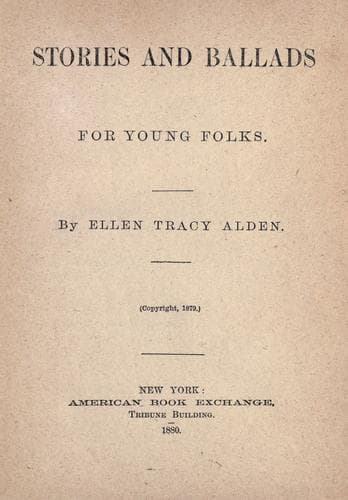
Stories and ballads for young folksAlden, Ellen Tracy
General
Stories and ballads for young folks
Alden, Ellen Tracy
Children -- Conduct of life -- Juvenile literature; Children's poetry; Children's stories; Conduct of life -- Juvenile literature
“Oh, yes, they do, sometimes. And you know you never will tell us
anything about the war;—does he, Katy?”
But Katy has quietly left the room.
“Well, Marie, once I woke up after a battle, and something, I couldn’t
see what, was tugging at my coat. There was a sun in the sky the last I
could remember. Now it was night, and a very dark night. I reached out
to feel what sort of creature this was. Then I first discovered that
my right hand was gone. But with the other I could feel the head and
long silken ears of a dog. He seemed pleased to have me notice him,
licked my face, and gamboled about, then commenced to tug at my clothes
again. He seemed to want something of me. I finally got up and tried to
follow him—tried, I say, because it is no easy matter to walk about the
field of battle the night after it has taken place. One is apt to find
obstacles in his way. As I groped along, and my eyes became accustomed to
the darkness, I could just distinguish from the surrounding shadows the
figure of this strange guide of mine. It was a monster of a dog—a black,
moving mass. I had known of one other like him. An idea occurred to me.
Perhaps this and that dog were the same. That dog’s name was Ponto. So
I called—‘Ponto?’ to try him. Back he came bounding, directly, leaping
upon me, and seemed quite delighted. I was pretty certain this was the
dog I knew. As I went along talking to him, some one spoke from among the
shadows—‘Is that you, Walt?’ There was only one person who had been wont
to address me after that fashion. He had recognized _my_ voice. Now I
recognized _his_. And it would have been strange, surely, if we had not
known each other’s voice. We were together at college for four years,
and great friends—‘most intimate,’ that is the expression, I believe. I
sometimes went home and spent vacation with him. (He lived in Virginia,
among the mountains.) And sometimes he came home with me. You would
hardly remember him; yet, when a very small carriage, containing a very
small child, used to stop at our door, he was always on hand to lift
out that little Mademoiselle and bring her in—only a dainty bundle of
embroideries, apparently, till two bright eyes peeped forth, and pretty
soon two little pink fists that would get at his hair and pull it, and
_that_ used to tickle him immensely. Yes, as I said, we were the best of
friends. Then suddenly there was a great gulf between us; and we saw, and
heard, and knew no more of each other. It appears that, though we were
not aware of it, we had been fighting against each other that very day.
But now Ponto had brought us together again, and we were glad enough to
meet. So glad we could forget, at last, that he belonged to the army of
the South, and I to the army of the Union. We had a great many matters to
talk over, not having seen each other in some time. Ah, but we _couldn’t_
see, as you know. So we had to be content with saying our farewells in
the dark. For that was the way our talk ended, Marie.
Public-domain text, read in full here on John Shaqi.
Reviews
Reviews
No reviews yet
Be the first to share your thoughts on this work.
Join the Discussion
Join the discussion
Sign in to leave a comment or review.
Sign InorCreate an account