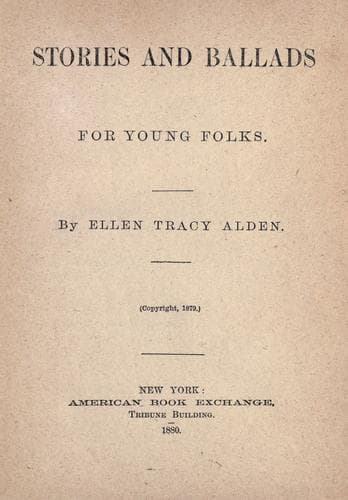
Stories and ballads for young folksAlden, Ellen Tracy
General
Stories and ballads for young folks
Alden, Ellen Tracy
Children -- Conduct of life -- Juvenile literature; Children's poetry; Children's stories; Conduct of life -- Juvenile literature
“The river flowing through our town is a mischievous river, sometimes,
especially in spring, when the snow is melting, and, overfed by the
streams from the hills, it comes rushing along, sweeping away dams and
bridges, and tearing about generally, in a very unreasonable fashion.
Yet farther on, at Factoryville, where it plunges over the rocks, it
keeps the mills going all the year round. In fact, there would be no
mills there if it were not for our brave little river ‘putting its
shoulder to the wheel.’ Besides, we must admit, it is quite an important
feature in the landscape, winding among the woods and fields, flashing
and shimmering in the sunlight. And how often you and I have stopped
to listen to the plash and ripple of its waters as we walked along the
banks. I remember what company that music was to me, one dark night, a
good while ago, when I was returning from a long tramp up the valley.
Just so, since the loss of my eyesight has made for me continual night,
you scarcely would believe, Harry, how many times I have been cheered by
your merry flow of spirits. As sister says, we have missed you. It is no
small thing to be missed by one’s friends when he is away from them. Nor
is such a good-for-nothing, stove-up piece of humanity as myself the only
one you can find to cheer, if you will look about you. Life is full of
shadows. It is a sorrowful sort of night to multitudes of people. Such
natures as yours were meant to make the darkness less dreary, and when
you come to the mill-wheels to turn them.”
“But the mill-wheels? I don’t exactly understand about that.”
“Well, for instance, the weather is growing cold; winter is not far
off. We sit here by a fire and find it very comfortable. There are a
good many to-night who haven’t any fire. We have had our supper. There
are a good many who must go without. If you will notice in the streets
to-morrow, you will see little feet shoeless, stockingless. People who go
without food, and fire, and sufficient clothing, get sick, have fevers,
diphtheria, what not? But, unfortunately, the fevers, and so forth, won’t
stay shut up in alleys and tumble-down tenements; they creep out, out
into the broad streets, into the fine mansions of brick and stone, and
all over the city, hunting for the cunning little Ediths, the pretty
Maries.”
“Oh, I never thought of that!”
“People who haven’t food, and fire, and warm clothing, often attempt to
steal them, or the wherewithal to pay for them. People who steal, if they
are caught at it, go to prison. When they come out again nobody will
trust them or employ them. Since they cannot find work, and have got to
live somehow, what must they do? Steal. So it comes about that a great
many people steal for a living. And where did all this crime commence?
Like the fevers, with the lack of food, and fire, and clothing. As
Tennyson’s ‘Northern Farmer’ says:—
Public-domain text, read in full here on John Shaqi.
Reviews
Reviews
No reviews yet
Be the first to share your thoughts on this work.
Join the Discussion
Join the discussion
Sign in to leave a comment or review.
Sign InorCreate an account