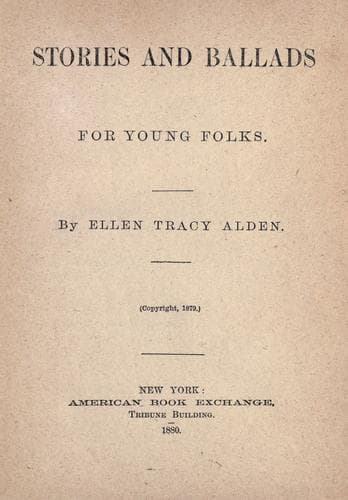
Stories and ballads for young folksAlden, Ellen Tracy
General
Stories and ballads for young folks
Alden, Ellen Tracy
Children -- Conduct of life -- Juvenile literature; Children's poetry; Children's stories; Conduct of life -- Juvenile literature
About two hundred years ago there lived a blind man who was the author of
what many think to be the greatest of poems. But wherever that wonderful
work is read and admired, there, too, it is told how his daughters, with
one exception, were unkind to him and undutiful, refusing even the task
of committing to paper those immortal verses. However, it may be he was a
trifle to blame, himself. (For we have seen, as in that other case, how
greatness does sometimes build for itself a barrier, a high, impassable
wall.) Suppose day after day little eyes looked up wistfully, and he
did not see—gazing far off into other worlds and other ages; little
voices whispered timidly, and he did not hear—listening to the converse
of angels; little hands clung caressingly, but unheeded. Ah, that was
asking for bread and getting a stone. Suppose it made some little hearts
ache, some little people were “afraid,” finally, like Edith, awhile
since. So when they grew up and he grew old and sightless, what came
of it all? _Paradise Lost_, to be marveled at as long as the English
language is known and studied, and there in shadowy background, the
mighty genius, poor and blind, with his unloving daughters.
And now, girl readers, here is that writing which to her, so sorrowful,
is like a consoling message from the Beyond.
FOR MY SWEET SAINT CATHERINE.
_There was once a blind, crippled, helpless hulk of humanity
who had a sister. And such a sister! All the women who ever
wrote books, or painted pictures, or spoke or sang to gaping
crowds, weren’t worth her little finger. At least, so he
thought—this selfish fellow—and with good reason. For he owed
it to her that life was not a burden; rather, he owed it to her
that life was a pleasure. Ah, what could she have done that
she did not do for him? Like a good fairy she hovered about
him, studying and scheming for his comfort and diversion from
morning till night. Would he be read to? She would read to him
by the hour. Did some rhyme or foolish fancy escape him? She
was only too eager to preserve it. She was eyes for him, she
was his good right hand, she was everything! Ah, how unmindful
of self, how thoughtful of him always! even striving to forget
some sorrows of her own, lest her sadness might make him sad!
And now that he is gone, and she has nothing to regret—not
one impatient word or act—and to remember only unwearied,
loving care, ceaseless devotion, let her be comforted. Surely
“she hath done what she could.” Oh, my sister, my sister, be
comforted! and let us dare hope that of those who watch over
thee, unseen, he who writes this may be one._
Public-domain text, read in full here on John Shaqi.
Reviews
Reviews
No reviews yet
Be the first to share your thoughts on this work.
Join the Discussion
Join the discussion
Sign in to leave a comment or review.
Sign InorCreate an account