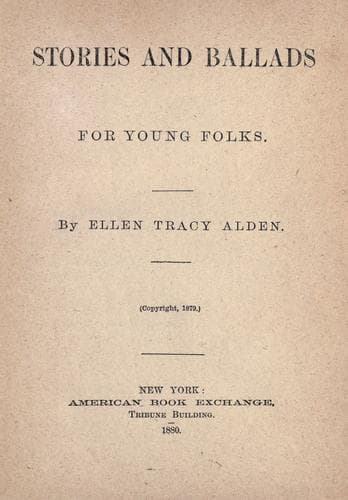
Stories and ballads for young folksAlden, Ellen Tracy
General
Stories and ballads for young folks
Alden, Ellen Tracy
Children -- Conduct of life -- Juvenile literature; Children's poetry; Children's stories; Conduct of life -- Juvenile literature
At the asylum, little orphans had a roof to shelter them from the storms,
a place to lay their tired selves at night, food to eat when they were
hungry, clothes to protect them from the cold. But there was no mamma
there, no Julien, no oncle le capitaine. The great clean rooms, with
their whitewashed walls, were so bare. No pretty mats on the floors,
no carved tables, no silken chairs and sofas, no crimson curtains, no
beautiful paintings and statuettes, as in that pleasant village home from
which Julie and her mother fled when the terrible armies came marching
on, with beat of drum and thundering of cannon. It was dreary and
lonesome here. Julie could not understand a word that was spoken, neither
could any one understand her. So she could not play with the other
children, but sat alone by herself watching them all day—watching in a
dream, the roar of the briny billows still ringing in her ears. Now and
then she cried a little for very homesickness; and always she wondered
why she was in this place and why Julien did not come.
One day a lady was shown into the school-room, where the children sang
for her. Looking about upon their faces she asked:
“Who is that delicate little creature in the corner, with the dark hair
and eyes?”
The matron told the story she had heard from Mrs. Lane. It was, she said,
a little orphan girl who had recently come over in an emigrant ship from
France. Her father was killed in the battle of Sedan. Did the lady know
of any one who would like to adopt the child?
“Why, I’ve a great mind to take her myself. She could play with Charlie
and Lizzie, you know,” turning to her companion, “and in that way they
could learn to speak French, couldn’t they?”
So, when this person—she was visiting some cousins in town—when she
returned home Julie went with her; why, she did not know, but she
supposed it must be the way to find her brother. To be sure, madame let
her hold Lizzie a good deal, and holding Lizzie made one’s arms ache.
What matter? Julien would be there, where they were going!
But when the long journey was ended, and they left the noisy train, and
monsieur met them, all smiles at the sight of wife and baby, and they
drove through the streets to monsieur’s house, Julien was not there! The
child was ready to cry from disappointment. She sat down by the window
and watched the passers-by. Perhaps one would be Julien. Now, a little
boy of five or six years, after being fondled and caressed by mamma, and
having given baby a dutiful but hasty kiss, came and planted himself in
front of her. When he had stared at her to his satisfaction, he demanded:
“Who be _you_?”
Julie could not understand, and so how could she answer?
“Who be _you_, I say?”
No reply.
“Why don’t you speak, you ninny, you?”
“Bonjour, mon ami,”[2] said Julie, scared at his rough tones.
“Bonny Jew!—what’s the rest of it? Bonny Jew! Bonny Jew! Ha, ha! What a
funny name!”
Charley caught up his cap and ran into the street to tell Willie Wade:
Public-domain text, read in full here on John Shaqi.
Reviews
Reviews
No reviews yet
Be the first to share your thoughts on this work.
Join the Discussion
Join the discussion
Sign in to leave a comment or review.
Sign InorCreate an account