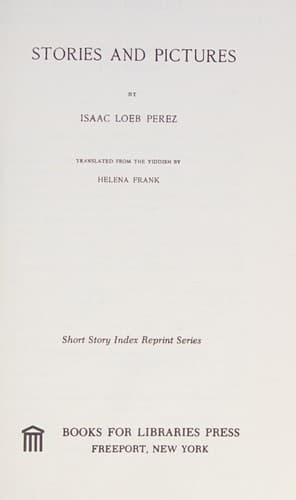
Jewish fiction; Jews -- Fiction; Peretz, Isaac Leib, 1851 or 1852-1915 -- Translations into English; Short stories
LEHAVDÎL Lit. "to distinguish." Elliptical for "to distinguish between
the holy and the secular." It is equivalent to "excuse the comparison";
"with due distinction"; "pardon me for mentioning the two things in the
same breath"; etc.
LULAV (pl. Lulavîm). The festal wreath used with the Esrog on the Feast
of Tabernacles. _See_ Lev. xxiii. 40.
MAARIV The evening service.
MASKIL An enlightened one; an "intellectual."
MINCHAH The afternoon service.
MINYAN A company of ten men, the minimum for a public service.
MISHNAH A code of laws. _See_ Talmud.
MISHNAYES Plural of Mishnah; specifically, the volumes containing the
Mishnah.
MISNAGID (pl. Misnagdîm). One opposed to the mystical teaching of the
Chassidîm.
MOHEL The one who performs the rite of circumcision.
PARNOSSEH Means of livelihood; sustenance.
RABBI Teacher of the Law; the religious guide and arbiter of a
community; also teacher, as at a Cheder.
REB Mr.
REBBE The acknowledged leader of the Chassidîm, usually a
wonder-worker; called also "Güter Yüd." and Tsaddik.
REBBITZIN Wife of a rabbi.
RÖFEH Jewish physician.
RUBLE (Russian). Russian coin worth about half a dollar.
SECHSER (Ger.). A small coin.
SHOCHET Ritual slaughterer.
SHOFAR Ram's horn, used on New Year's Day, etc. _See_ Lev. xxiii. 24.
SHOOL (Ger., Schul'). Synagogue.
SIMCHAS TORAH. The Festival of Rejoicing in the Law, the ninth day of
the Feast of Tabernacles.
SLICHES Penitential prayers. Applied to the week, more or less, before
the New Year, when these prayers are recited at the synagogue.
STÜBELE (Ger.). Chassidic meeting-house.
TAKI (Russian). Really.
TALLIS Prayer-scarf.
TALMUD The traditional lore of the Jews, reduced to writing about 500
of the present era. It consists of the Mishnah and the Gemoreh.
TALMUD TORAH. Free communal school.
TEFILLIN Phylacteries.
TIKERIN Assistant at the women's bath.
TORAH The Jewish Law in general, and the Pentateuch in particular.
TOSSAFOT An important commentary on the Talmud, composed chiefly by
Franco-German authorities.
TSADDIK Lit. "righteous man"; specifically, a Rebbe, a wonder-worker, a
"Güter Yüd."
The Lord Baltimore Press BALTIMORE, MD., U. S. A.
* * * * *
Changes made in the text
(not of the etext transcriber):
staid longer=>stayed longer
* * * * *
FOOTNOTES:
[1] A Bible commentator of the sixteenth century.
[2] Conveyance opportunely going the same way.
[3] Shatnez, mixture of wool and linen, forbidden in the Pentateuch.
[4] From the Talmudical treatise on damages.
[5] College.
[6] Five good marks, the highest number given in the Russian schools.
[7] The correct name of the town.
[8] The tenth of Tishri. New Year is Tishri 1.
[9] Holy day. Hebrew.
[10] In desperate cases of illness, people vow to supply the synagogue
with candles equal to the length of certain parts of the cemetery.
[11] Small lumps of dough dropped into the soup while it is cooking.
Public-domain text, read in full here on John Shaqi.
Reviews
Reviews
No reviews yet
Be the first to share your thoughts on this work.
Elsewhere in the archive
Join the Discussion
Join the discussion
Sign in to leave a comment or review.
Sign InorCreate an account