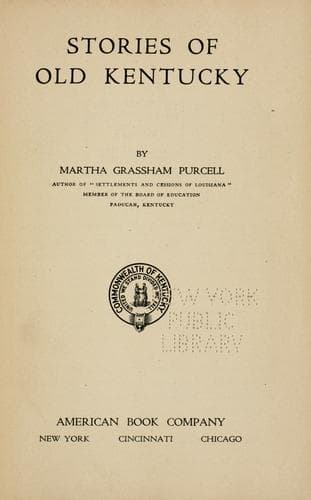
Stories of Old KentuckyPurcell, Martha C. Grassham, Mrs.
History
Stories of Old Kentucky
Purcell, Martha C. Grassham, Mrs.
Kentucky -- History
Tusks were found from seven to eleven feet long, the latter being at the
larger end six or seven inches in diameter. Thigh bones, five feet in
length; teeth weighing ten pounds with crowns seven by five inches;
skulls, thought to be of young animals, measuring two feet between the
eyes; ribs from three to four inches broad and so long that James
Douglas and his party used them for tent poles, are some of the wonders
that have given the name to this historic place. Scientists have decided
from these remains that these ponderous animals belonged to the elephant
family. Though possessing remarkable strength, they were so unwieldy
that prehistoric man encountered little danger in combating them. It is
the supposition that the early inhabitants who occupied this continent
when these marvelous animals roamed the woods, must have planned to
exterminate them on their periodic visits to the lick. By what means
this was accomplished we can only conjecture, but that there was a
wholesale slaughter is evident, for at no other place have so many
mammoth remains been found.
THE DRUID OF KENTUCKY
Daniel Boone was born in the almost unbroken forests of Pennsylvania, on
February 11, 1735. Without his energy, caution, and daring, Kentucky
would not have been settled so soon. In both his native state and in
North Carolina, he received in his boyhood the training that was to fit
him for the great work that was to be his.
Truly "coming events cast their shadows before," for when barely large
enough to shoulder the old family flintlock he found unbounded delight
in roaming the woods and returning laden with his spoils, which at one
time was the skin of an immense panther that he shot just as it was
about to spring upon him.
[Illustration: "They found Boone in camp."]
While yet in his early teens he gave his family great alarm by being
absent for two days and nights. A rescuing party was sent out, and they
soon saw smoke rising in the distance; proceeding, they found Boone in
camp, his floor carpeted with the skins of animals he had slain, while
the delicious odor of roasted meat filled the air.
Boone was in every way a typical backwoodsman. His education was limited
to an imperfect knowledge of the "three R's," gained in the rude school
cabin of round logs, puncheon seats, and dirt floor. Ever the solitude
of the sylvan forests was far more enjoyable to him than the refinements
of civilization.
In 1755 he was married to Rebecca Bryan, who with him shared much of the
danger and hardships of frontier life.
In 1769, yielding to the siren song sung by John Finley of the far-famed
cane land with its fertile soil, towering mountains, limpid streams, and
rich meadowlands where the spoils of the chase were venison, bear, and
buffalo, Boone left his family and friends on the Yadkin in North
Carolina and came with Finley and four others to explore this marvelous
land of "Kentuckee."
Public-domain text, read in full here on John Shaqi.
Reviews
Reviews
No reviews yet
Be the first to share your thoughts on this work.
Join the Discussion
Join the discussion
Sign in to leave a comment or review.
Sign InorCreate an account