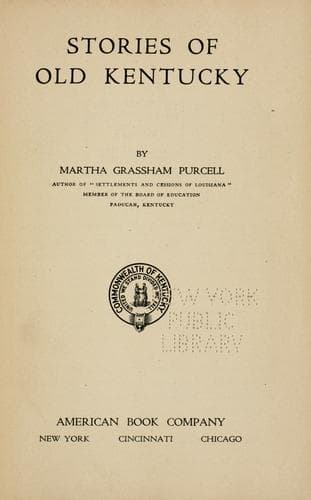
Stories of Old KentuckyPurcell, Martha C. Grassham, Mrs.
History
Stories of Old Kentucky
Purcell, Martha C. Grassham, Mrs.
Kentucky -- History
During the eighteenth century, many men, singly or in companies, enjoyed
the beauties of the forest scenes of Kentucky. Always they carried back
to the centers of civilization the most glowing accounts of hill and
dale and stream, of the abundance of game and fish, of the fertility of
the soil, and of the glorious monarchs of the forest. These hardy
woodsmen had the inherent love of Nature in her wildest, most gorgeous
aspects. They were pioneers, hunters, and trappers. To some these terms
convey only the thought of rough, unsophisticated men with none of the
benevolent qualities of head or heart, with no magnanimity of spirit
for a friend and nothing but the most intense hatred for a foe. But the
lives of some of these frontiersmen furnish incidents from which we
might well take lesson.
One of these, James Harrod, though unable to write his name, has so
indelibly impressed it upon the annals of the early times that as long
as history is read he will be famous. In May, 1774, Captain Harrod with
about thirty men descended the Monongahela and the Ohio in canoes to the
mouth of the Kentucky River. Penetrating the forest, they built the
first log cabin ever erected in Kentucky, at the place where Harrodsburg
now stands. Here a town was laid off and called Harrodstown. After four
or five cabins had been built depredations of the Indians caused them to
be deserted until the following spring, when Harrod with many of his
former comrades and several others returned. This place was subsequently
called Oldtown and later Harrodsburg, fittingly commemorating the grand
pioneer who built not only the first cabin but the first town in our
commonwealth.
James Harrod was by nature endowed with all the qualities of a great
leader; he is described as tall and commanding, energetic and fearless,
honest and generous, ignorant yet intelligent. Inured to difficulties
and dangers, familiar with the forest, skillful with his rifle, he was a
success as a hunter, but a terror to his foes. He was a real leader of
the pioneers. In the words of Marshall, "He always had a party, not
because he wanted a party, but because the party wanted him."
Unremitting in the care of his companions, unrelenting in his attacks on
the "red rascals," untiring in services to his neighbors and friends, he
was truly a nobleman, with a lofty yet gentle spirit. "If news came of
an Indian massacre, he snatched his gun and ran at the head of the
party; if he knew of a family left destitute, he shouldered his rifle
and ranged the forest till he found the game to supply their needs; if
he heard of a horse being lost he stopped not till he drove him to his
owner's gate." Thus he was known by his contemporaries. Yet he seemed
not to be ambitious. Only as a delegate from Harrodstown and as a
colonel of the militia is he found in civil affairs. But the magnanimity
of his spirit shone forth at all times.
Public-domain text, read in full here on John Shaqi.
Reviews
Reviews
No reviews yet
Be the first to share your thoughts on this work.
Join the Discussion
Join the discussion
Sign in to leave a comment or review.
Sign InorCreate an account