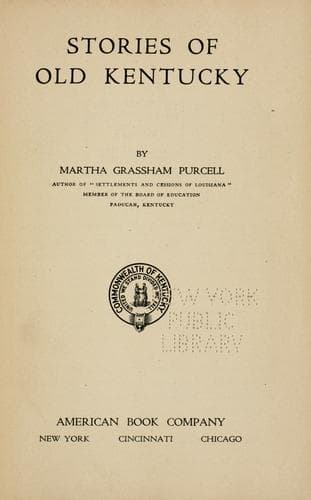
Stories of Old KentuckyPurcell, Martha C. Grassham, Mrs.
History
Stories of Old Kentucky
Purcell, Martha C. Grassham, Mrs.
Kentucky -- History
So these boys and girls of those far-away days, although they had no
well-warmed, well-lighted, well-ventilated schoolhouses; although their
teachers were not always so scholarly and cultured as one could wish;
although often in the earliest days they had no attractive textbooks,
and their only means of learning to read, write, and calculate was from
copies set by their teachers; although instead of paper they used smooth
boards on which to write, with the juice of the oak balls for ink;
although when they could read there were no absorbing storybooks,--yet
they made progress and perhaps studied as hard as some children of
to-day.
HOW THE PIONEERS MADE CHANGE
We of to-day, with half dollars, quarter dollars, dimes, nickels, and
pennies, often find it difficult to "make change." Still more difficult
was it for the early settlers to do so.
As the Indians used wampum and the early settlers of Virginia, tobacco,
so the pioneers of Kentucky used the skins of wild animals as their
first currency. While immigrants continued to come to this region,
Spanish silver dollars came gradually into circulation. Still there was
no small change.
As "Necessity is the mother of invention," our forefathers actually made
change by cutting the dollar into four equal parts, each worth
twenty-five cents. These were again divided, each part worth twelve and
one half cents, called bits. People sometimes became careless in the
work of making change and often cut the dollar into five "quarters" or
into ten "eighths." On account of the wedge shape of these pieces of cut
money, they were called "sharp shins."
If change was needed for a smaller sum than twelve and one half cents,
merchants gave pins, needles, writing paper, and such things.
This cut silver gradually found its way back to the mint for recoinage,
usually to the loss of the last owner. As late as 1806, a business house
in Philadelphia received over one hundred pounds of cut silver, brought
on by a Kentucky merchant, which was sent on a dray to the United States
Mint for recoinage.
A WOMAN'S WILL
"Where there is a will, there is a way" is an oft-quoted proverb, and
the first white woman of whom we have any record of entering Kentucky
proved it true. In 1756 Mrs. Mary Draper Inglis, her two small sons, and
a sister-in-law, Mrs. Draper, were taken from their homes in Virginia by
the Shawnee Indians and carried some distance down the Kanawha, where
they halted a few days to make salt, thence to the Indian village at the
mouth of the Scioto, which is the site now of Portsmouth, Ohio. Mrs.
Inglis won her way into the favor of the savages by making shirts of
material that French traders had brought from Detroit. She was soon held
in such high esteem by her captors that she was not subjected to the
peril of running the gantlet, though a greater grief was put upon
her,--that of being separated from her two sons at the division of the
prisoners.
Public-domain text, read in full here on John Shaqi.
Reviews
Reviews
No reviews yet
Be the first to share your thoughts on this work.
Join the Discussion
Join the discussion
Sign in to leave a comment or review.
Sign InorCreate an account