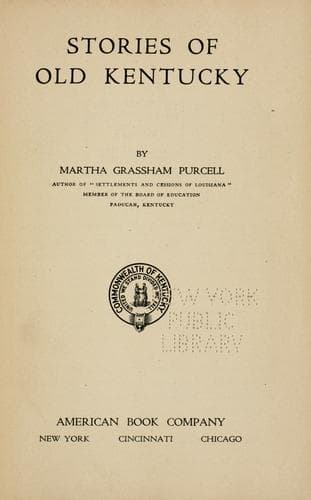
Stories of Old KentuckyPurcell, Martha C. Grassham, Mrs.
History
Stories of Old Kentucky
Purcell, Martha C. Grassham, Mrs.
Kentucky -- History
One of the men was anxious to know the number of the Indians. So, though
he was lying on his back, and was the middle man, he determined to turn
over and peep at the crowd below. The other two white men determined he
should keep still; so they held him, but as he quietly struggled, a pole
broke and with a terrible crash, clapboards, men, and guns fell upon the
frightened savages, who with yells of terror fled into the forest and
never returned. Though almost as much terrified as the Indians, the
white men quietly enjoyed the fire till morning, when they returned to
the station with their trophies of what they laughingly called "The
Battle of the Boards."
THE FAITHFUL SLAVE AND HIS REWARD
If we search the annals of both ancient and modern times we can find no
record that shows greater fidelity from slave to master than was
exhibited by a negro to one of Kentucky's most noted pioneers.
In 1782, March 19, people living in the vicinity of Boonesborough
discovered some empty rafts floating down the river. They at once knew
that Indians had used them to cross the stream so as to attack the
unprotected settlements. News was sent to the various stations warning
the settlers. Colonel Logan dispatched fifteen men to Estill's Station,
where they were joined by twenty-five from that fort. Under the command
of Captain James Estill, they started to pursue and punish the invaders.
Early in the morning of the 20th, Miss Jennie Gass, with a slave, Monk,
as protector, went just outside the fort at Estill's Station to milk the
cows. Her mother, seeing the savages approaching, called loudly for her
to run, but the warning came too late. Ere her daughter could reach the
gate, her mother saw her tomahawked and scalped.
Monk was captured and asked about the force of the fort. Like the
half-witted boy who was questioned by the Tories, Monk exaggerated the
situation, saying there were forty men in the fort then molding bullets
in anticipation of an attack. The truth is that aside from the women and
children, there were only four men, who were too disabled to march. The
savages accordingly thought it best to retreat.
No sooner had they withdrawn from the vicinity of the fort than two boys
were dispatched to find Captain Estill's band and tell them of the
tragedy. In a few hours the messengers found the men, and so uneasy were
some of the party for their families that five returned to help protect
the fort, while the other thirty-five began to search for the trail of
the Indians. A part of the horses became so jaded that ten more dropped
from the ranks, while the remaining twenty-five pushed forward with a
grim determination to find the savages.
Public-domain text, read in full here on John Shaqi.
Reviews
Reviews
No reviews yet
Be the first to share your thoughts on this work.
Join the Discussion
Join the discussion
Sign in to leave a comment or review.
Sign InorCreate an account