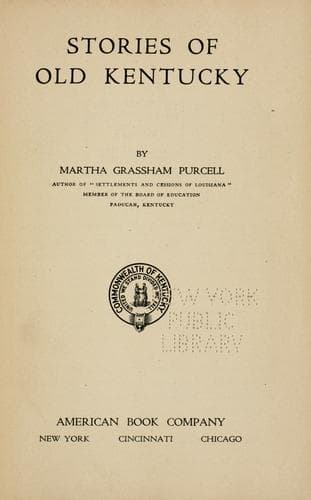
Stories of Old KentuckyPurcell, Martha C. Grassham, Mrs.
History
Stories of Old Kentucky
Purcell, Martha C. Grassham, Mrs.
Kentucky -- History
When but a little girl one of my greatest delights was to sit at the
feet of my maternal grandfather and listen to the tales of the olden
times. Grandfathers and grandmothers always love to tell stories, and
boys and girls love to hear them. Our grandparents were not the only
ones that enjoyed telling stories of the great past; Indians also
related many things to their children of what had happened in the long
ago. But as the red men had no books in which to record these
happenings, some of their stories may be of real incidents and a great
deal may be purely imaginary, for we know the Indian was always very
superstitious.
[Illustration: The Indians loved to tell stories to their children.]
There is a story told by the Lenni-Lenape Indians, who lived in eastern
United States, that their ancestors in the very earliest times were
mere animals living underground. One of them accidentally found a hole
by which he came to the surface of the ground, and soon the whole tribe
followed. These Indians believed that they gradually became human
beings; so in remembrance of their ancestors, they chose such names as
"Black Bear," "Black Hawk," "Red Horse," and "Sitting Bull." Some of the
tribes believing in this tradition would not eat any underground animals
like the rabbit, ground hog, and ground squirrel, for fear they would be
eating their kinsmen.
Another very interesting tradition told by these Lenni-Lenape, or
Delawares, is that these ancestors came from west of the Mississippi and
that when they tried to cross this stream the right of passage was
disputed by a powerful force called the Alligewi, from whose name we get
the word Allegheny. Being determined to cross this mighty stream and
move eastward, the Lenni-Lenape joined with the Mengwe (Iroquois) in a
war upon the Alligewi, overcame them, and almost exterminating them,
drove the remnant of their tribe entirely from the country.
General G.R. Clark, Colonel McKee, and Colonel James Moore at different
times and places were told by Indians, among them the noted chiefs
"Cornstalk" and "Tobacco," that before the red men came to
Kentucky--named from Ken-tuck-ee, meaning in Indian language, "the river
of Blood"--a white race, superior in many arts and crafts unknown to
the red men, the builders of the many forts, and the inhabitants of the
vast burying grounds, had been besieged by the early Indians in a great
battle near the Falls of the Ohio. The remnant was driven into a small
island below these rapids, where the entire race was "cut to pieces."
Public-domain text, read in full here on John Shaqi.
Reviews
Reviews
No reviews yet
Be the first to share your thoughts on this work.
Join the Discussion
Join the discussion
Sign in to leave a comment or review.
Sign InorCreate an account