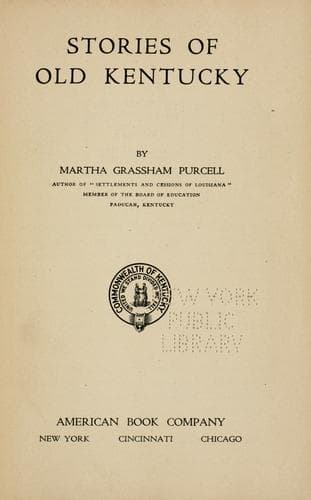
Stories of Old KentuckyPurcell, Martha C. Grassham, Mrs.
History
Stories of Old Kentucky
Purcell, Martha C. Grassham, Mrs.
Kentucky -- History
About 1784, a party of pioneers left the Falls of the Ohio with the
intention of descending the river. Reaching Yellow Banks, the boat
stopped for a while. One of the party, a Mr. Rowan, taking a loaded gun,
but no ammunition, wandered some distance from the shore and upon his
return was astonished to find the boat gone. The crew had cause to
believe a party of Indians was near, so hastened away without waiting
for their comrade. The nearest settlement was at Vincennes, one hundred
miles distant. So thither Mr. Rowan bent his steps until after three
weary days of exposure and exhaustion he abandoned all hope and lay
down to die. It was not long, however, before, hearing the report of a
gun, he again took courage, rose, and made his way in the direction of
the sound. When he came in sight, an Indian raised his gun to fire, but,
seeing Mr. Rowan turn the butt of his gun, knew he meant to be friendly;
so with a politeness that would have done honor to a civilian the savage
promptly turned the butt of his also.
Learning the destitute condition of Rowan, the Indian hospitably took
him to his wigwam, cared for him until his strength was restored, and
then conducted him to Vincennes. Anxious to reward such unusual
kindness, Rowan tried to prevail on the savage to accept a gift of $300;
of this the Indian nobly refused every penny, but in order to please his
recent guest finally accepted a new blanket, saying, "When I wrap myself
in it, I will think of you."
SAVED BY THE HUG OF A BEAR
Though the records of pioneer life teem with startling encounters with
wild animals, there really occurred a very unusual incident, when the
life of a young man, named Downing, was saved by the hug of a bear.
In those early days, the people of that part of the country that is now
Kentucky had to content themselves with very rough cabins and forts for
their families, and with no outbuildings or inclosures whatever for
their stock.
Instead of well-kept stables and excellent pastures, the stockade
protected the cows, sheep, and horses at night, and the near-by forest
was their home and grazing ground during the day. Although as close
watch as possible was kept over these animals, they sometimes strayed so
far away that it was necessary to bring them back or the Indians would
take them for their own.
In the year 1786, in what is now Bath County, a horse had strayed off,
and a young man named Yates requested another occupant of the fort, a
mere lad named Downing, to go with him in search of the animal.
They traversed the woods in every direction all day, but in vain. About
sundown, when nearly seven miles from the fort, in a wild valley,
Downing became very anxious concerning sounds that seemed to follow his
footsteps regardless of the direction he took. He repeatedly said that
he heard sticks breaking and that he believed Indians were following
them.
Public-domain text, read in full here on John Shaqi.
Reviews
Reviews
No reviews yet
Be the first to share your thoughts on this work.
Join the Discussion
Join the discussion
Sign in to leave a comment or review.
Sign InorCreate an account