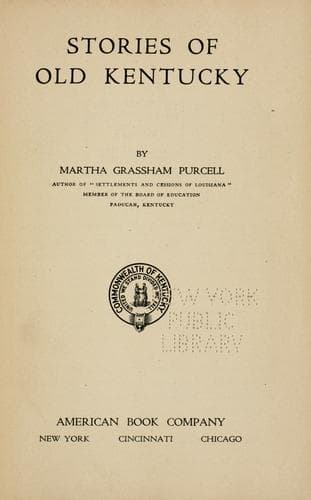
Stories of Old KentuckyPurcell, Martha C. Grassham, Mrs.
History
Stories of Old Kentucky
Purcell, Martha C. Grassham, Mrs.
Kentucky -- History
Most of the people were of French descent and had been taught by the
British that the Kentuckians waged savage warfare. They were therefore
terror-stricken until General Clark assured them that their own king,
whose rule over them had been exchanged for that of the British by the
treaty of Paris, 1763, had joined hands with America to stop the cruel
war of the British and Indians. The French colonists were then
overjoyed, said their French king had come to life, and offered to
accompany the division that was to march to Cahokia.
On July 6, that post was also surprised and taken; the inhabitants were
dreadfully alarmed at the sight of the "big knife," but were soon
reassured by their relatives and friends from Kaskaskia.
Not satisfied with these brilliant successes, General Clark felt that he
must also capture Vincennes, but M. Gibault, the village priest of both
that place and Kaskaskia, volunteered to inform the people of Vincennes
that the king of France had become an ally of the American colonists.
Soon the American flag floated over that fort and from the Lakes to the
Mississippi the powerful arm of the British was broken, and the many
Indian invasions of Kentucky were discontinued.
A FAMOUS MARCH
News came to General Clark in January of 1779, that the British under
Governor Hamilton from Detroit had recaptured Vincennes and were waiting
only till spring to advance with hundreds of Indian allies on Kaskaskia,
obliterate the Kentuckians, and break the power of Virginia west of the
Alleghenies. Learning at the same time that Hamilton had only about
eighty regular soldiers with three cannons and some swivels, Clark
decided not to wait to be attacked, but to take the aggressive. He at
once sent forty-five men on a boat to proceed to a point near the mouth
of the White River with instructions, to allow nothing to pass, and to
wait further orders.
Nine days after the important information reached him, General Clark
with one hundred and seventy men started across flooded prairies,
swollen streams, and inundated valleys. There is no more daring march
recorded. Trudging through rain and mud, fording small streams, wading
most of the time in deep water ofttimes to the armpits, they traveled
without tents, depending on parched corn and the securing of game for
food; at last they went for days with no nourishment whatever.
[Illustration: Clark and his men crossing a swollen stream.]
Public-domain text, read in full here on John Shaqi.
Reviews
Reviews
No reviews yet
Be the first to share your thoughts on this work.
Join the Discussion
Join the discussion
Sign in to leave a comment or review.
Sign InorCreate an account