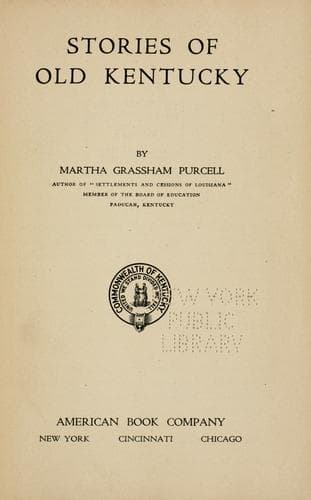
Stories of Old KentuckyPurcell, Martha C. Grassham, Mrs.
History
Stories of Old Kentucky
Purcell, Martha C. Grassham, Mrs.
Kentucky -- History
An act of this court caused a log jail and courthouse to be built where
Danville now stands. Immigrants continued to come to this "Eden of the
West" and the three original counties were divided and subdivided until
June 1, 1792, when Kentucky became the fifteenth star in the
constellation. There were then nine counties with a total population of
100,000; from this embryo has come a commonwealth of one hundred and
twenty counties, with an area of four thousand square miles, rich in
minerals and timber, factories and fields.
From the mountains of the east and the blue grass of the central part,
even to the "Pennyrile" of the far west, each son of the "Dark and
Bloody Ground" loves the land settled by Boone, Kenton, and Clark.
KENTUCKY IN THE REVOLUTION
The youth of our state may feel that because Kentucky was not one of the
original Thirteen Colonies to make the heroic struggle for freedom, that
she played no part in establishing and extending our national
government.
During this period, remote as was this part of Virginia from the centers
of civilization, every road blazed, every settlement made, every victory
over the red savage, had a far-reaching effect, not alone for the state
in embryo, but for the national government.
Had not the pioneers of Kentucky, with the heroism of the Romans of old,
subdued the savages, stopped their depredations, and secured to the
mother state of Virginia that vast tract out of which have been carved
Michigan, Wisconsin, Ohio, Indiana, and Illinois, the power of England,
to-day, might cut our continent in two.
Kentuckians waited not for opportunity but made it.
At the battle of Point Pleasant, in October, 1774, where the noted
"Cornstalk" met defeat, there were with General Andrew Lewis men whose
name and fame furnish much of Kentucky history. There were Harrod, the
Shelbys, the Boones, and other intrepid leaders who afterwards brought
out from chaos our infant commonwealth.
The effect of this battle was more than local. It gave peace to the
frontiersmen at the time the colonies were beginning the crucial contest
with England and for a while prevented that barbaric warfare waged by
the British and Indians united. So severe was the slaughter, it is said,
that blood was found on each tree behind which the Indians and pioneers
were posted.
Public-domain text, read in full here on John Shaqi.
Reviews
Reviews
No reviews yet
Be the first to share your thoughts on this work.
Join the Discussion
Join the discussion
Sign in to leave a comment or review.
Sign InorCreate an account