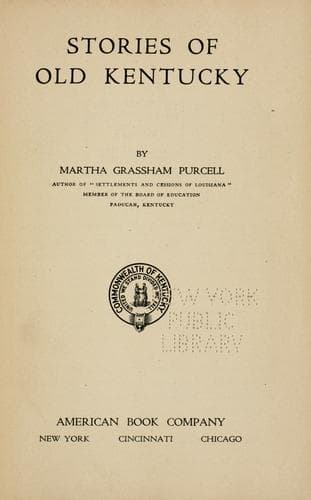
Stories of Old KentuckyPurcell, Martha C. Grassham, Mrs.
History
Stories of Old Kentucky
Purcell, Martha C. Grassham, Mrs.
Kentucky -- History
Though the stalwart pioneers, dressed in their primitive suits of
deerskin or homespun, pushed farther and farther into Kentucky, stopping
not for privation or peril, danger or disaster, climbing cliffs, fording
streams, fighting savages, yet they were not all merely unlettered
backwoodsmen hunters and fighters. Though the education of nearly all
was more or less limited, a number of these early courageous Kentuckians
have made unusual contributions to the useful sciences. If not the
birthplace, Kentucky was the home and the burial place of a trio who can
claim priority in the invention of the steamboat.
In 1778 there came to Kentucky from Connecticut a man of vigorous
intellect and remarkable powers of perseverance, John Fitch. He had
formerly been a silversmith, clock maker, and lieutenant in the
Revolutionary forces from New Jersey. Though made captive by the Indians
and held prisoner for a year, yet in 1780, as he gazed upon the
beautiful Ohio, he had the first conception of overcoming currents by a
new mode of navigation. Retiring to his surveyor's camp he pondered,
and, remembering the work of Watt with steam, concluded that boats could
be propelled by the same power.
[Illustration: Fitch's steamboat.]
The story of his struggles, in petitions and disappointments, reminds
one of Columbus, as he so long in vain sought aid to make his first
voyage to America. In 1787, 1788, and 1789, Fitch built several boats,
that made from four to seven and one half miles per hour between
Philadelphia and Burlington. He petitioned the legislatures of a number
of states as well as England, France, and Spain, and obtained not
money, but the exclusive privileges of navigating certain streams by
boats propelled by fire or steam. He became discouraged and finally
despaired; he died at Bardstown, 1798, where his remains rest.
A pathetic circumstance connected with his invention is related. He
wrote three volumes of manuscript, sealed them, and placed them in the
Philadelphia Library to be opened thirty years after his death. When
opened, they touchingly related his disappointments, brilliantly
foretold the perfection of his plans, and sorrowfully and bitterly said,
"The day will come when some more powerful man will get fame and riches
from my invention; but nobody will believe that poor John Fitch can do
anything worthy of attention."
Public-domain text, read in full here on John Shaqi.
Reviews
Reviews
No reviews yet
Be the first to share your thoughts on this work.
Elsewhere in the archive
Join the Discussion
Join the discussion
Sign in to leave a comment or review.
Sign InorCreate an account