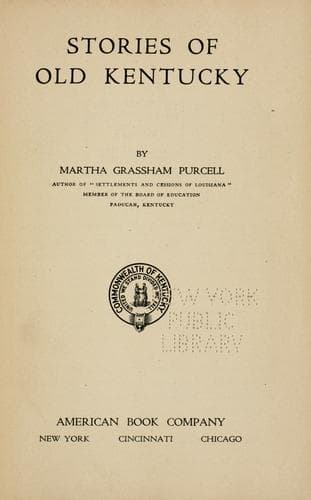
Stories of Old KentuckyPurcell, Martha C. Grassham, Mrs.
History
Stories of Old Kentucky
Purcell, Martha C. Grassham, Mrs.
Kentucky -- History
The gifted Kentuckian, Henry Clay, had by his pacific measures postponed
war, but it was not to be averted. When it came, our governor, Beriah
Magoffin, attempted neutrality, and refused to raise troops for either
army. From many homes, however, went soldiers to each side; friend was
arrayed against friend, brother against brother, and father against son.
The hour of patriotism, danger, and privation had come. When the first
gun in the war was fired at Fort Sumter, South Carolina, a native
Kentuckian, Major Robert Anderson of the United States army, commanded
the garrison.
On our soil both Confederate and Federal forces were raised. Various
towns were occupied and fortified by soldiers, at some places under the
Stars and Bars, at other places under the Stars and Stripes.
The boys that wore the gray entered Kentucky and fortified themselves at
Columbus and Hickman under Major General Leonidas Polk, and at
Cumberland Gap under General Zollicoffer. The boys in blue, acting under
orders from Brigadier General U.S. Grant, invaded the state at Paducah.
General Albert Sidney Johnston of Kentucky took command of the
Confederate "Central Army of Kentucky," and under his orders General
Simon B. Buckner fortified Bowling Green.
At Wildcat Mountain, near London, a bloody conflict took place, General
Zollicoffer leading the Confederates, and Colonel T.T. Garrard and
General Schoepff the Federals. The Confederates, being outnumbered,
withdrew, after a loss to each side.
At Sacramento, Colonel Forrest defeated a company of Federals two days
after Christmas, 1861.
Early the next year General Zollicoffer and General George B.
Crittenden encountered General Thomas at Mill Springs; reënforcements
came to the Federals, the gallant Zollicoffer fell, and the Confederates
were forced to retreat.
At Big Hill, in Rockcastle County, the Federals were defeated; at
Richmond the Confederates were again victorious, while at Munfordville
they were repulsed.
At Augusta a bloody battle between Colonel Basil Duke's men and the home
guards under Dr. Joshua T. Bradford resulted in another victory for the
Confederates.
In the severe battle of Perryville, where 25,000 Federals, under General
A. McCook, met 16,000 Confederates under General William J. Hardee, the
Federal loss was more than four thousand and the Confederate, one
thousand less. This was one of the most desperately contested battles of
the war.
[Illustration: Gen. John H. Morgan.]
That daring Confederate cavalryman, General John H. Morgan, the "Francis
Marion" of the Confederacy, captured Glasgow, Elizabethtown, and the
blockhouses at Muldraugh's Hill, where he tore up the railroad track.
Colonel Cluke defeated the Federals at Mount Sterling, destroyed
railway trains, and captured supplies.
Public-domain text, read in full here on John Shaqi.
Reviews
Reviews
No reviews yet
Be the first to share your thoughts on this work.
Elsewhere in the archive
Join the Discussion
Join the discussion
Sign in to leave a comment or review.
Sign InorCreate an account