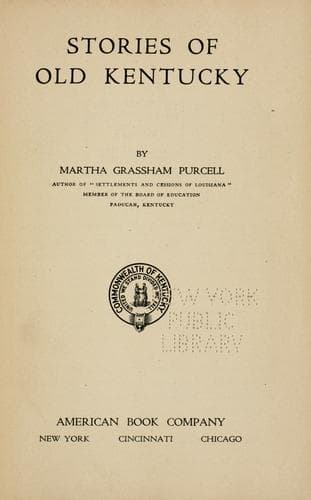
Stories of Old KentuckyPurcell, Martha C. Grassham, Mrs.
History
Stories of Old Kentucky
Purcell, Martha C. Grassham, Mrs.
Kentucky -- History
In 1453, while this exchange was at its height, the Turks conquered
Constantinople, seized the caravan routes, and ruined the trade. Gold
and pearls, ivory and diamonds, spices and silks, could no longer be
secured unless a waterway could be found to the East.
Prince Henry the Navigator, a Portuguese, though many of his captains
thought that in the torrid zone the ocean was boiling and that flames
filled the air, succeeded in reaching almost to the equator before his
death in 1460. In 1487, Diaz continued the work to the Cape of Good
Hope. Christopher Columbus, believing the earth a sphere, thought that
by sailing due westward only two thousand five hundred miles he would
reach China and India. So in August, 1492, after seeking aid in vain
from Portugal, England, and his own country, he braved the "Sea of
Darkness" in a Spanish ship. Though some Portuguese sailors had said,
"You might as well expect to find land in the sky as in that waste of
waters," in October of the same year he made the discovery that gave to
the world a new continent.
Then the spirit of adventure and aggrandizement dominated the Spanish
race. Ponce de León, Fernando Cortez, Pizarro, and Fernando de Soto
continued the work until June, 1543. Luis de Moscoso, the successor of
de Soto, with a remnant of his once proud force, now reduced to about
three hundred men, in boats descended the Mississippi River to its
mouth; from the boats they were the first white men to behold the land
that is now Kentucky.
England, so far, had been very quiet and conservative about discovering,
exploring, or settling. Finally, English fishermen came to Newfoundland.
Sir John Hawkins traded negroes for hides and pearls, and Sir Francis
Drake ravaged the Caribbean coast and in 1577-1580 sailed around the
world. Soon Sir Humphrey Gilbert attempted colonization, which was
taken up by his half brother, Sir Walter Raleigh, who sent two ships
under Philip Amadas and Arthur Barlowe, who discovered the coast of
North Carolina. Upon their return, Queen Elizabeth named it Virginia.
Kentucky was included in the charter of this first colony, which was
settled at Jamestown, 1607.
Public-domain text, read in full here on John Shaqi.
Reviews
Reviews
No reviews yet
Be the first to share your thoughts on this work.
Join the Discussion
Join the discussion
Sign in to leave a comment or review.
Sign InorCreate an account