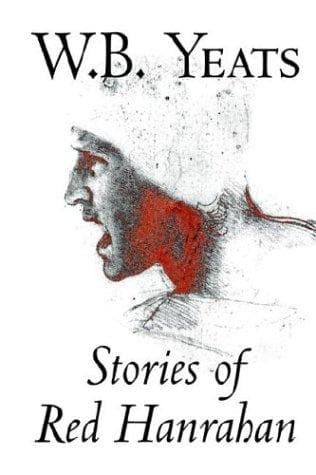
Stories of Red HanrahanYeats, W. B. (William Butler)
General
Stories of Red Hanrahan
Yeats, W. B. (William Butler)
Ireland -- Social life and customs -- Fiction
One fine May morning a long time after Hanrahan had left Margaret
Rooney's house, he was walking the road near Collooney, and the sound
of the birds singing in the bushes that were white with blossom set him
singing as he went. It was to his own little place he was going, that
was no more than a cabin, but that pleased him well. For he was tired of
so many years of wandering from shelter to shelter at all times of the
year, and although he was seldom refused a welcome and a share of what
was in the house, it seemed to him sometimes that his mind was getting
stiff like his joints, and it was not so easy to him as it used to be to
make fun and sport through the night, and to set all the boys laughing
with his pleasant talk, and to coax the women with his songs. And a
while ago, he had turned into a cabin that some poor man had left to
go harvesting and had never come to again. And when he had mended the
thatch and made a bed in the corner with a few sacks and bushes, and
had swept out the floor, he was well content to have a little place for
himself, where he could go in and out as he liked, and put his head in
his hands through the length of an evening if the fret was on him, and
loneliness after the old times. One by one the neighbours began to send
their children in to get some learning from him, and with what they
brought, a few eggs or an oaten cake or a couple of sods of turf, he
made out a way of living. And if he went for a wild day and night now
and again to the Burrough, no one would say a word, knowing him to be a
poet, with wandering in his heart.
It was from the Burrough he was coming that May morning, light-hearted
enough, and singing some new song that had come to him. But it was not
long till a hare ran across his path, and made away into the fields,
through the loose stones of the wall. And he knew it was no good sign a
hare to have crossed his path, and he remembered the hare that had led
him away to Slieve Echtge the time Mary Lavelle was waiting for him, and
how he had never known content for any length of time since then. 'And
it is likely enough they are putting some bad thing before me now,' he
said.
And after he said that he heard the sound of crying in the field beside
him, and he looked over the wall. And there he saw a young girl sitting
under a bush of white hawthorn, and crying as if her heart would break.
Her face was hidden in her hands, but her soft hair and her white
neck and the young look of her, put him in mind of Bridget Purcell and
Margaret Gillane and Maeve Connelan and Oona Curry and Celia Driscoll,
and the rest of the girls he had made songs for and had coaxed the heart
from with his flattering tongue.
Public-domain text, read in full here on John Shaqi.
Reviews
Reviews
No reviews yet
Be the first to share your thoughts on this work.
Join the Discussion
Join the discussion
Sign in to leave a comment or review.
Sign InorCreate an account