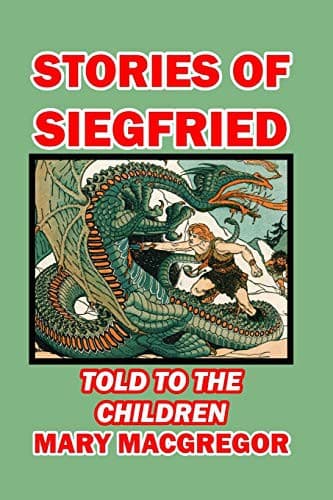
Stories of Siegfried, Told to the ChildrenMacgregor, Mary
General
Stories of Siegfried, Told to the Children
Macgregor, Mary
Nibelungenlied -- Adaptations; Siegfried (Legendary character) -- Juvenile literature
Yet Siegfried had no wish to conquer the warrior-queen and gain her
hand and her broad dominions for his own. Siegfried thought only of a
wonder-maiden, unknown, unseen as yet, though in his heart he hid an
image of her as he dreamed that she would be.
It is true that Siegfried had no love for the haughty Brunhild. It is
also true that he wished to prove to her that he alone was a match for
all her boldest warriors, and had even power to bewitch her magic
steed, Gana, if so he willed, and steal it from her side.
And so one day a spirit of mischief urged the Prince on to a gay
prank, as also a wayward spirit urged him no longer to brook Queen
Brunhild's haughty mien.
Before he left Isenland, therefore, Siegfried in a merry mood threw to
the ground the seven great gates that guarded the Queen's strong
castle. Then he called to Gana, the magic steed, to follow him into
the world, and this the charger did with right good-will.
Whether Siegfried sent Gana back to Isenland or not I do not know, but
I know that in the days to come Queen Brunhild never forgave the hero
for his daring feat.
When the Prince had left Isenland he rode on and on until he came to a
great mountain. Here near a cave he found two little dwarfish
Nibelungs, surrounded by twelve foolish giants. The two little
Nibelungs were princes, the giants were their counsellors.
Now the King of the Nibelungs had but just died in the dark little
underground town of Nibelheim, and the two tiny princes were the sons
of the dead king.
But they had not come to the mountain-side to mourn for their royal
father. Not so indeed had they come, but to divide the great hoard of
treasure which the King had bequeathed to them at his death.
Already they had begun to quarrel over the treasure, and the twelve
foolish giants looked on, but did not know what to say or do, so they
did nothing, and never spoke at all.
The dwarfs had themselves carried the hoard out of the cave where
usually it was hidden, and they had spread it on the mountain-side.
There it lay, gold as far as the eye could see, and farther. Jewels,
too, were there, more than twelve waggons could carry away in four
days and nights, each going three journeys.
Indeed, however much you took from this marvellous treasure, never did
it seem to grow less.
But more precious even than the gold or the jewels of the hoard was a
wonderful sword which it possessed. It was named Balmung, and had been
tempered by the Nibelungs in their glowing forges underneath the glad
green earth.
Before the magic strength of Balmung's stroke, the strongest warrior
must fall, nor could his armour save him, however close its links had
been welded by some doughty smith.
As Siegfried rode towards the two little dwarfs, they turned and saw
him, with his bright, fair face, and flowing locks.
Nimble as little hares they darted to his side, and begged that he
would come and divide their treasure. He should have the good sword
Balmung as reward, they cried.
Public-domain text, read in full here on John Shaqi.
Reviews
Reviews
No reviews yet
Be the first to share your thoughts on this work.
Join the Discussion
Join the discussion
Sign in to leave a comment or review.
Sign InorCreate an account