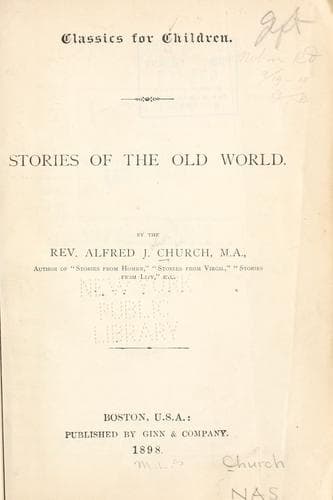
Mythology, Greek -- Juvenile literature; Mythology, Roman -- Juvenile literature
“’Tis well,” said Ulysses, “and now I will despatch this watcher to the
ship, whom I will send again in pilot’s disguise if thou desire, and
it seems needful. Also I myself will depart, and may Hermes, the god of
craft, and Athené, who ever is with me, cause us to prevail.”
After a while Philoctetes came up the path to the cave, very slowly,
and with many groans. And when he saw the strangers (for now some of
the ship’s crew were with Prince Neoptolemus) he cried, “Who are ye
that are come to this inhospitable land? Greeks I know you to be by
your garb; but tell me more.”
And when the Prince had told his name and lineage, and that he was
sailing from Troy, Philoctetes cried, “Sayest thou from Troy? Yet
surely thou didst not sail with us in the beginning.”
“What?” cried the Prince. “Hadst thou then a share in this matter of
Troy?”
And Philoctetes made reply, “Knowest thou not whom thou seest? Hast
thou not heard the story of my sorrows?” And when he heard that the
young man knew nothing of these things: “Surely this is sorrow upon
sorrow if no report of my state hath come to the land of Greece, and I
lie here alone, and my disease groweth upon me, but my enemies laugh
and keep silence!” And then he told his name and fortunes, and how the
Greeks had left him on the shore while he slept, and how it was the
tenth year of his sojourning in the island. “For know,” he said, “that
it is without haven or anchorage, and no man cometh hither of his free
will; and if any come unwilling, as indeed it doth sometimes chance,
they speak soft words to me and give me, haply, some meat; but when I
make suit to them that they carry me to my home, they will not. And
this wrong the sons of Atreus and Ulysses have worked against me; for
which may the gods who dwell in Olympus make them equal recompense.”
“And I,” said the Prince, “am no lover of these men. For when Achilles
was dead----”
“How sayest thou? Is the son of Peleus dead?”
“Yea; but it was the hand of a god and not of a man that slew him.”
“A mighty warrior slain by a mighty foe! But say on.”
“Ulysses, and Phœnix who was my sire’s foster-father, came in a ship to
fetch me; and when I was come to the camp they even greeted me kindly,
and sware that it was Achilles’ self they saw, so like was I to my
sire. And, my mourning ended, I sought the sons of Atreus and asked of
them the arms of my father, but they made answer that they had given
them to Ulysses; and Ulysses, chancing to be there, affirmed that they
had done well, seeing that he had saved them from the enemy. And when I
could prevail nothing, I sailed away in great wrath.”
“’Tis even,” Philoctetes made reply, “as I should have judged of them.
But I marvel that the Greater Ajax endured to see such doings.”
“Ah! but he was already dead.”
“This is grievous news. And how fares old Nestor of Pylos?”
“But ill, for his eldest born, Antilochus, is dead.”
Public-domain text, read in full here on John Shaqi.
Reviews
Reviews
No reviews yet
Be the first to share your thoughts on this work.
Elsewhere in the archive
Join the Discussion
Join the discussion
Sign in to leave a comment or review.
Sign InorCreate an account