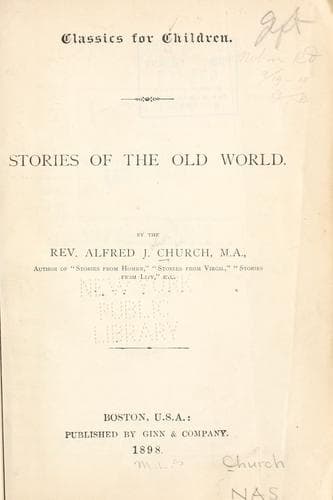
Mythology, Greek -- Juvenile literature; Mythology, Roman -- Juvenile literature
“I could have spared any rather than these two, Ajax and Antilochus.
But Patroclus, where was he when thy father died?”
“He was already slain. For ’tis ever thus that war taketh the true man
and leaveth the false. But of these things I have had enough and more
than enough. Henceforth my island of Scyros, though it be rocky and
small, shall content me. And now, Prince Philoctetes, I go, for the
wind favors us, and we must take the occasion which the gods give us.”
And when Philoctetes knew that Neoptolemus was about to depart, he
besought him with many prayers that he would take him also on his ship;
for the voyage, he said, would not be of more than a single day. “Put
me,” he said, “where thou wilt, in forecastle, or hold, or stern, and
set me on shore even as it may seem best to thee. Only take me from
this place.” And the sailors also made entreaty to the Prince that he
would do so; and he, after a while, made as if he consented to their
prayers.
But while Philoctetes was yet thanking him and his companions, there
came two men to the cave, of whom one was a sailor in the Prince’s
ship, and the other a merchant. And the merchant said that he was
sailing from Troy to his home, and that chancing to come to the island,
and knowing that the Prince was there, he judged it well to tell him
his news; ‘twas briefly this, that Phœnix and the sons of Theseus had
sailed, having orders from the sons of Atreus that they should bring
the Prince back; and also that Ulysses and Diomed were gone on another
errand, even to fetch some one of whom the rulers had need. And when
the Prince would know who he might be, the merchant bade him say who it
was standing near; and when he heard that it was Philoctetes, he cried,
“Haste thee to thy ship, son of Achilles, for this is the very man whom
the two are coming to fetch. Haply thou hast not heard what befell
at Troy. There is a certain Helenus, son of King Priam, and a famous
soothsayer. Him Ulysses, the man of craft, took a prisoner, and brought
into the assembly of Greeks; and the man prophesied to them that they
should never take the city of Troy, unless they should bring thither
the Prince Philoctetes from the island whereon he dwelt. And Ulysses
said, ‘If I bring not the man, whether willing or unwilling, then cut
off my head.’”
And when Philoctetes heard this his anger was very great, and he became
yet more eager to depart. But first he must go into the cave and fetch
such things as he needed, herbs with which he was wont to soothe the
pains of his wounds, and all the furniture of his bow. And when he
spake of the bow, the Prince asked whether it was indeed the famous bow
of Hercules that he carried in his hand, and would fain, he said, touch
it, if only it were lawful so to do. And Philoctetes answered, “Yes,
thou shalt touch it and handle it, which, indeed, no other man hath
ever done, for thou hast done a good deed to me, and it was for a good
deed that I myself also received it.”
Public-domain text, read in full here on John Shaqi.
Reviews
Reviews
No reviews yet
Be the first to share your thoughts on this work.
Elsewhere in the archive
Join the Discussion
Join the discussion
Sign in to leave a comment or review.
Sign InorCreate an account