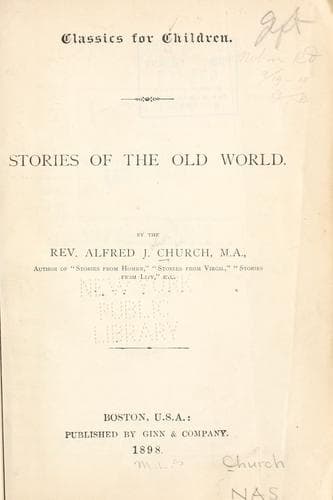
Mythology, Greek -- Juvenile literature; Mythology, Roman -- Juvenile literature
“Home that hast watched with me, farewell!
And nymphs that haunt the springs or dwell
In seaward meadows, and the roar
Of waves that break upon the shore;
Where often, through the cavern’s mouth,
The drifting of the rainy South
Hath coldly drenched me as I lay;
And Hermes’ hill, whence many a day,
When anguish seized me, to my cry
Hoarse-sounding echo made reply.
O fountains of the land, and thou,
Pool of the Wolf, I leave you now;
Beyond all hope I leave thy strand,
O Lemnos, sea-encircled land!
Grant me with favoring winds to go
Whither the mighty Fates command,
And this dear company of friends,
And mastering Powers who shape our ends
To issues fairer than we know.”
CHAPTER VII.
It fell out that at the last Troy was taken by a stratagem. Now the
stratagem was this: The Greeks made a great Horse of wood, feigning it
to be a peace-offering to the gods, that they might have a safe return
to their homes.
In the belly of this there hid themselves certain of the bravest of the
chiefs, as Menelaüs, and Ulysses, and Thoas the Ætolian, and Machaon,
the great physician, and Pyrrhus, son of Achilles (but Achilles himself
was dead, slain by Paris, Apollo helping, even as he was about to take
the city), and others also, and with them Epeius himself. But the rest
of the people made as if they had departed to their homes; only they
went not further than Tenedos, which was an island near to the coast.
Great joy was there in Troy when it was noised abroad that the men of
Greece had departed. The gates were opened, and the people went forth
to see the plain and the camp. And one said to another, as they went,
“Here they set the battle in array, and there were the tents of the
fierce Achilles, and there lay the ships.” And some stood and marvelled
at the great peace-offering to Minerva, even the Horse of wood. And
Thymœtes, who was one of the elders of the city, was the first who
advised that it should be brought within the walls and set in the
citadel. Now whether he gave this counsel out of a false heart, or
because the gods would have it so, no man knows. But Capys, and others
with him, said that it should be drowned in water, or burned with fire,
or that men should pierce it and see whether there were aught within.
And the people were divided, some crying one thing and some another.
Then came forward the priest Laocoön, and a great company with him,
crying, “What madness is this? Think ye that the men of Greece are
indeed departed, or that there is any profit in their gifts? Surely,
there are armed men in this mighty Horse; or haply they have made it
that they may look down upon our walls. Touch it not, for as for these
men of Greece, I fear them, even though they bring gifts in their
hands.”
And as he spake he cast his great spear at the Horse, so that it
sounded again. But the gods would not that Troy should be saved.
Public-domain text, read in full here on John Shaqi.
Reviews
Reviews
No reviews yet
Be the first to share your thoughts on this work.
Elsewhere in the archive
Join the Discussion
Join the discussion
Sign in to leave a comment or review.
Sign InorCreate an account