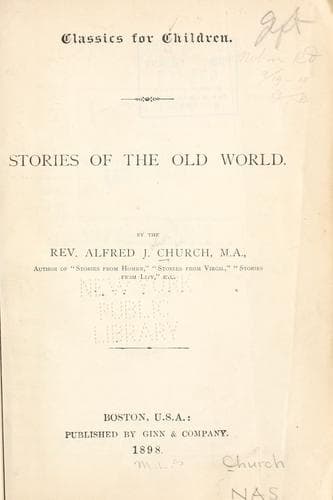
Mythology, Greek -- Juvenile literature; Mythology, Roman -- Juvenile literature
Meanwhile there came certain shepherds, dragging with them one whose
hands were bound behind his back. He had come forth to them, they said,
of his own accord, when they were in the field. And first the young men
gathered about him mocking him, but when he cried aloud, “What place is
left for me, for the Greeks suffer me not to live, and the men of Troy
cry for vengeance upon me?” they rather pitied him, and bade him speak,
and say whence he came and what he had to tell.
Then the man spake, turning to King Priam: “I will speak the truth,
whatever befall me. My name is Sinon, and I deny not that I am a Greek.
Haply thou hast heard the name of Palamedes, whom the Greeks slew, but
now, being dead, lament; and the cause was that, because he counselled
peace, men falsely accused him of treason. Now, of this Palamedes I was
a poor kinsman, and followed him to Troy. And when he was dead, through
the false witness of Ulysses, I lived in great grief and trouble, nor
could I hold my peace, but sware that if ever I came back to Argos I
would avenge me of him that had done this deed. Then did Ulysses seek
occasion against me, whispering evil things, nor rested till at the
last, Calchas the soothsayer helping him--but what profit it that I
should tell these things? For doubtless ye hold one Greek to be even
as another. Wherefore slay me, and doubtless ye will do a pleasure to
Ulysses and the sons of Atreus.”
Then they bade him tell on, and he said,--
“Often would the Greeks have fled to their homes, being weary of the
war, but still the stormy sea hindered them. And when this Horse that
ye see had been built, most of all did the dreadful thunder roll from
the one end of the heaven to the other. Then the Greeks sent one
who should inquire of Apollo; and Apollo answered them thus: ‘Men
of Greece, even as ye appeased the winds with blood when ye came to
Troy, so must ye appease them with blood now that ye would go from
thence.’ Then did men tremble to think on whom the doom should fall,
and Ulysses, with much clamor, drew forth Calchas the soothsayer
into the midst, and bade him say who it was that the gods would
have as a sacrifice. Then did many forebode evil for me. Ten days
did the soothsayer keep silence, saying that he would not give any
man to death. But then, for in truth the two had planned the matter
beforehand, he spake, appointing me to die. And to this thing they all
agreed, each being glad to turn to another that which he feared for
himself. But when the day was come, and all things were ready, the
salted meal for the sacrifice and the garlands, lo! I burst my bonds
and fled, and hid myself in the sedges of a pool, waiting till they
should have set sail, if haply that might be. But never shall I see
country, or father, or children again. For doubtless on these will they
take vengeance for my flight. Only do thou, O king, have pity on me,
who have suffered many things, not having harmed any man.”
Public-domain text, read in full here on John Shaqi.
Reviews
Reviews
No reviews yet
Be the first to share your thoughts on this work.
Elsewhere in the archive
Join the Discussion
Join the discussion
Sign in to leave a comment or review.
Sign InorCreate an account