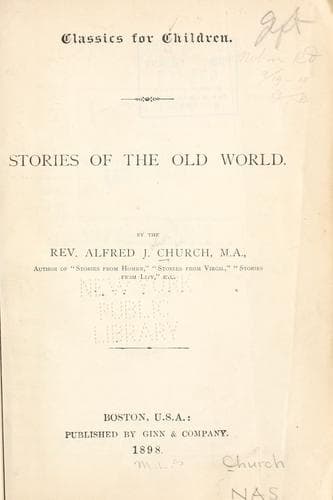
Mythology, Greek -- Juvenile literature; Mythology, Roman -- Juvenile literature
All that day the wise Ulysses was thinking what he might best do to
save himself and his companions, and the end of his thinking was this:
there was a mighty pole in the cave, green wood of an olive tree, big
as a ship’s mast, which Polyphemus purposed to use, when the smoke
should have dried it, as a walking staff. Of this he cut off a fathom’s
length, and his comrades sharpened it and hardened it in the fire, and
then hid it away. At evening the giant came back, and drove his sheep
into the cave, nor left the rams outside, as he had been wont to do
before, but shut them in. And having duly done his shepherd’s work,
he made his cruel feast as before. Then Ulysses came forward with the
wine-skin in his hand, and said,--
“Drink, Cyclops, now that thou hast feasted. Drink and see what
precious things we had in our ship. But no one hereafter will come to
thee with such like, if thou dealest with strangers as cruelly as thou
hast dealt with us.”
Then the Cyclops drank, and was mightily pleased, and said, “Give me
again to drink, and tell me thy name, stranger, and I will give thee a
gift such as a host should give. In good truth this is a rare liquor.
We, too, have vines, but they bear not wine like this, which indeed
must be such as the gods drink in heaven.”
Then Ulysses gave him the cup again, and he drank. Thrice he gave it
to him, and thrice he drank, not knowing what it was, and how it would
work within his brain.
Then Ulysses spake to him. “Thou didst ask my name, Cyclops. Lo! my
name is No Man. And now that thou knowest my name, thou shouldst give
me thy gift.”
And he said, “My gift shall be that I will eat thee last of all thy
company.”
And as he spoke he fell back in a drunken sleep. Then Ulysses bade his
comrades be of good courage, for the time was come when they should be
delivered. And they thrust the stake of olive wood into the fire till
it was ready, green as it was, to burst into flame, and they thrust it
into the monster’s eye; for he had but one eye, and that in the midst
of his forehead, with the eyebrow below it. And Ulysses leant with all
his force upon the stake, and thrust it in with might and main. And the
burning wood hissed in the eye, just as the red-hot iron hisses in the
water when a man seeks to temper steel for a sword.
Then the giant leapt up, and tore away the stake, and cried aloud, so
that all the Cyclopes who dwelt on the mountain side heard him and
came about his cave, asking him, “What aileth thee, Polyphemus, that
thou makest this uproar in the peaceful night, driving away sleep? Is
any one robbing thee of thy sheep, or seeking to slay thee by craft or
force?”
And the giant answered, “No Man slays me by craft.”
“Nay, but,” they said, “if no man does thee wrong, we cannot help thee.
The sickness which great Zeus may send, who can avoid? Pray to our
father, Poseidon, for help.”
Then they departed; and Ulysses was glad at heart for the good success
of his device, when he said that he was No Man.
Public-domain text, read in full here on John Shaqi.
Reviews
Reviews
No reviews yet
Be the first to share your thoughts on this work.
Elsewhere in the archive
Join the Discussion
Join the discussion
Sign in to leave a comment or review.
Sign InorCreate an account