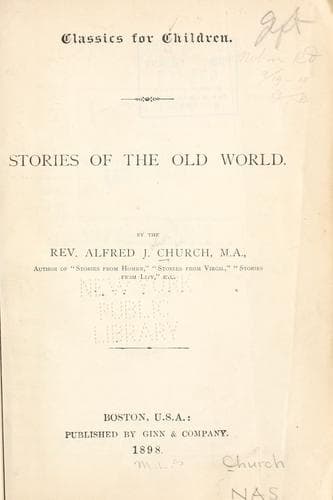
Mythology, Greek -- Juvenile literature; Mythology, Roman -- Juvenile literature
But the Cyclops rolled away the great stone from the door of the
cave, and sat in the midst, stretching out his hands to feel whether
perchance the men within the cave would seek to go out among the sheep.
Long did Ulysses think how he and his comrades should best escape. At
last he lighted upon a good device, and much he thanked Zeus for that
this once the giant had driven the rams with the other sheep into the
cave. For, these being great and strong, he fastened his comrades under
the bellies of the beasts, tying them with osier twigs, of which the
giant made his bed. One ram he took, and fastened a man beneath it,
and two others he set, one on either side. So he did with the six, for
but six were left out of the twelve who had ventured with him from the
ship. And there was one mighty ram, far larger than all the others,
and to this Ulysses clung, grasping the fleece tight with both his
hands. So they waited for the morning. And when the morning came, the
rams rushed forth to the pasture; but the giant sat in the door and
felt the back of each as it went by, nor thought to try what might be
underneath. Last of all went the great ram. And the Cyclops knew him as
he passed, and said,--
“How is this, thou, who art the leader of the flock? Thou art not wont
thus to lag behind. Thou hast always been the first to run to the
pastures and streams in the morning, and the first to come back to the
fold when evening fell; and now thou art last of all. Perhaps thou art
troubled about thy master’s eye, which some wretch--No Man, they call
him--has destroyed, having first mastered me with wine. He has not
escaped, I ween. I would that thou couldst speak, and tell me where he
is lurking. Of a truth I would dash out his brains upon the ground, and
avenge me of this No Man.”
So speaking, he let him pass out of the cave. But when they were out
of reach of the giant, Ulysses loosed his hold of the ram, and then
unbound his comrades. And they hastened to their ship, not forgetting
to drive before them a good store of the Cyclops’ fat sheep. Right glad
were those that had abode by the ship to see them. Nor did they lament
for those that had died, though they were fain to do so, for Ulysses
forbade, fearing lest the noise of their weeping should betray them to
the giant, where they were. Then they all climbed into the ship, and
sitting well in order on the benches, smote the sea with their oars,
laying-to right lustily, that they might the sooner get away from the
accursed land. And when they had rowed a hundred yards or so, so that a
man’s voice could yet be heard by one who stood upon the shore, Ulysses
stood up in the ship and shouted,--
“He was no coward, O Cyclops, whose comrades thou didst so foully slay
in thy den. Justly art thou punished, monster, that devourest thy
guests in thy dwelling. May the gods make thee suffer yet worse things
than these!”
Public-domain text, read in full here on John Shaqi.
Reviews
Reviews
No reviews yet
Be the first to share your thoughts on this work.
Elsewhere in the archive
Join the Discussion
Join the discussion
Sign in to leave a comment or review.
Sign InorCreate an account