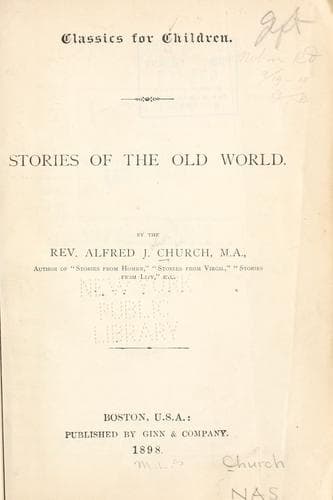
Mythology, Greek -- Juvenile literature; Mythology, Roman -- Juvenile literature
But Ulysses was sore troubled to hear such things, and wept aloud,
saying, “Who shall guide us in this journey?--for never yet did ship
make such a voyage as this.”
Then said Circé, “Seek no guide; only raise the mast of thy ship and
spread the white sails, and sit in peace. So shall the north wind
bear thee to the place on the ocean shore where are the groves of
Persephoné, tall poplars and willows. There must thou beach thy ship.
And after that thou must go alone.”
Then she told him all that he must do if he would hold converse with
the dead seer Tiresias, and hear what should befall him. So the next
morning he roused his companions, telling them that they should now
return. But it chanced that one of them, Elpenor by name, was sleeping
on the roof, for the coolness, being heavy with wine. And when he heard
the stir of his comrades, he rose up, nor thought of the ladder, but
fell from the roof and brake his neck. And the rest being assembled,
Ulysses told them how they must take another journey first, even to the
dwellings of the dead. This they were much troubled to hear, yet they
made ready the ship and departed.
So they came to the place of which Circé had told them. And when all
things had been rightly done, Ulysses saw spirits of the dead. First of
all came Elpenor, and he marvelled much to see him, saying,--
“How camest thou hither?--on foot or in the ship?”
Then he answered, telling how he had died; and he said, “Now, as thou
wilt go back, I know, to the island of Circé, suffer me not to remain
unburied, but make above me a mound of earth, for men in aftertimes to
see, and put upon it my oar, with which I was wont to row while I yet
lived.”
These things Ulysses promised that he would do. Afterwards came the
spirit of Tiresias, holding a sceptre of gold in his hand. And when
Ulysses asked him of his return, he said,--
“Thy return shall be difficult, because of the anger of Poseidon,
whose son thou madest blind. Yet, when thou comest to the island of
the Three Capes, where feed the oxen of the Sun, if thou leave these
unhurt, thou and thy comrades shall return to Ithaca. But otherwise
they shall perish, and thou shalt return, after long time, in a ship
not thine own, and shalt find in thy palace, devouring thy goods, men
of violence, suitors of thy wife. These shalt thou slay, openly or by
craft. Nor yet shalt thou rest, but shalt go to a land where men know
not the sea, nor eat their meat with salt; and thou shalt carry thy
oar on thy shoulder. And this shall be a sign to thee, when another
wayfarer, meeting thee, shall ask whether it be a winnowing fan that
thou bearest on thy shoulder; then shalt thou fix thy oar in the earth,
and make a sacrifice to Poseidon, and so return. So shalt thou die at
last in peace.”
Public-domain text, read in full here on John Shaqi.
Reviews
Reviews
No reviews yet
Be the first to share your thoughts on this work.
Elsewhere in the archive
Join the Discussion
Join the discussion
Sign in to leave a comment or review.
Sign InorCreate an account