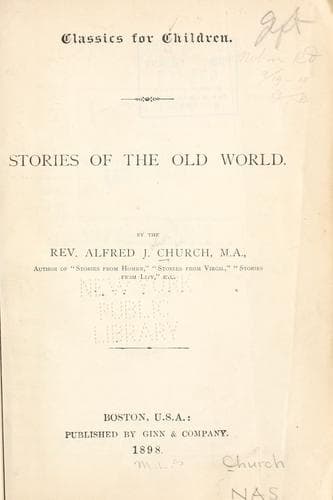
Mythology, Greek -- Juvenile literature; Mythology, Roman -- Juvenile literature
Then Tiresias departed. After this he saw his mother, and asked how it
fared with his home in Ithaca, and she told him all. And many others
he saw, wives and daughters of the heroes of old time. Also there came
King Agamemnon, who told him how Ægisthus, with Clytemnestra, his
wicked wife, had slain him in his own palace, being newly returned from
Troy. Fain would the King have heard how it fared with Orestes, his
son, but of this Ulysses could tell him nothing. Then came the spirit
of Achilles, and him Ulysses comforted, telling him how bravely and
wisely his son Neoptolemus had borne himself in Troy.
Also he saw the spirit of Ajax, son of Telamon; but Ajax spake not to
him, having great wrath in his heart, because of the arms of Achilles.
For the two, Ajax and Ulysses, had contended for them, Achilles being
dead, before the assembly of the Greeks, and the Greeks had given them
to Ulysses, whereupon Ajax, being very wroth, had laid hands upon
himself.
And having seen many other things, Ulysses went back to his ship, and
returned with his companions to the island of Circé. And being arrived
there, first they buried Elpenor, making a mound over him, and setting
up on it his oar, and afterwards Circé made them a feast. But while the
others slept she told to Ulysses all that should befall him, saying,--
“First thou wilt come to the island of the Sirens, who sing so sweetly,
that whosoever hears them straightway forgets wife and child and home.
In a meadow they sit, singing sweetly, but about them are bones of men.
Do thou, then, close with wax the ears of thy companions, and make them
bind thee to the mast, so that thou mayest hear the song and yet take
no hurt. And do thou bid them, when thou shalt pray to be loosed, not
to hearken, but rather to bind thee the more. And this peril being
past, there lie others in thy path, of which thou must take thy choice.
For either thou must pass between the rocks which the gods call the
Wanderers--and these close upon all that passes between them, even the
very doves in their flight, nor has any ship escaped them, save only
the ship _Argo_, which Heré loved--or thou must go through the strait,
where there is a rock on either hand. In the one rock dwells Scylla,
in a cave so high above the sea that an archer could not reach it with
his arrow. A horrible monster is she. Twelve unshapely feet she hath,
and six long necks, and on each a head with three rows of teeth. In
the cave she lies, but her heads are without, fishing for sea-dogs and
dolphins, or even a great whale, if such should chance to go by. Think
not to escape her, Ulysses, for, of a truth, with each head will she
take one of thy companions. But the other rock is lower and more flat,
with a wild fig-tree on the top. There Charybdis thrice a day draws
in the dark water, and thrice a day sends it forth. Be not thou near
when she draws it in; not even Poseidon’s self could save thee. Choose
Public-domain text, read in full here on John Shaqi.
Reviews
Reviews
No reviews yet
Be the first to share your thoughts on this work.
Elsewhere in the archive
Join the Discussion
Join the discussion
Sign in to leave a comment or review.
Sign InorCreate an account