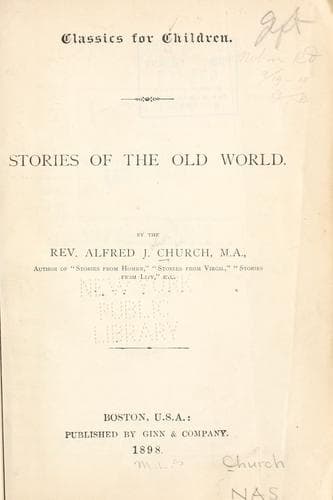
Mythology, Greek -- Juvenile literature; Mythology, Roman -- Juvenile literature
And when the Queen and her maidens came into the hall (for it was their
work to cleanse it and make it ready for the morrow), Penelopé asked
him of his family and his country. And at first he made as though he
would not answer, fearing, he said, lest he should trouble her with
the story of that which he had suffered. But afterwards, for she urged
him, telling him what she herself had suffered, her husband being lost
and her suitors troubling her without ceasing, he feigned a tale that
should satisfy her. For he told her how that he was a man of Crete, a
brother of King Idomeneus, and how he had given hospitality to Ulysses,
what time he was sailing to Troy with the sons of Atreus.
And when the queen, seeking to know whether he spake the truth, asked
him of Ulysses what manner of man he was, and with what clothing he was
clothed, he answered her rightly, saying, “I remember me that he had a
mantle, twofold, woollen, of sea-purple, clasped with a brooch of gold,
whereon was a dog that held a fawn by the throat; marvellously wrought
they were, so hard held the one, so strove the other to be free. Also
he had a tunic, white and smooth, which the women much admired to see.
But whether some one had given him these things I know not, for indeed
many gave him gifts, and I also, even a sword and a tunic. Also he had
a herald with him, one Eurybates, older than him, dark-skinned, round
in the shoulders, with curly hair.”
And Penelopé knowing these things to be true, wept aloud, crying that
she should see her husband no more. But the false beggar comforted her,
saying that Ulysses was in the land of the Thresprotians, having much
wealth with him, only that he had lost his ships and his comrades, yet
nevertheless would speedily return.
Then Penelopé bade her servants make ready a bed for the stranger of
soft mats and blankets, and also that one of them should bathe him. But
the mats and blankets he would not have, saying that he would sleep as
before; and for the bathing, he would only that some old woman, wise
and prudent, should do this. Wherefore the queen bade Euryclea, the
keeper of the house, do this thing for him, for that he had been the
comrade of her lord, and indeed was marvellously like to him in feet
and hands.
And this the old woman was right willing to do, for love for her
master, “for never,” she said, “of all strangers that had come to the
land, had come one so like to him.” But when she had prepared the bath
for his feet, Ulysses sat by the fire, but as far in the shadow as he
might, lest the old woman should see a great scar that was upon his
leg, and know him thereby.
Public-domain text, read in full here on John Shaqi.
Reviews
Reviews
No reviews yet
Be the first to share your thoughts on this work.
Elsewhere in the archive
Join the Discussion
Join the discussion
Sign in to leave a comment or review.
Sign InorCreate an account