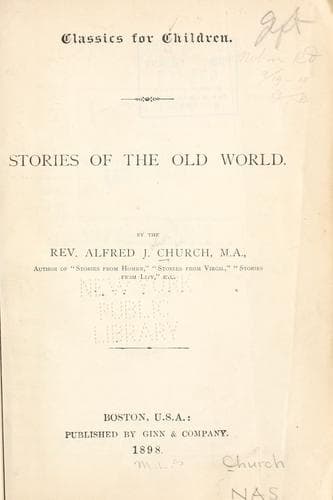
Mythology, Greek -- Juvenile literature; Mythology, Roman -- Juvenile literature
Now the scar had chanced in this wise. He had come to see his
grandfather Autolycus, who was the most cunning of men, claiming
certain gifts which he had promised to him in the old days when, being
then newly born, he was set on his grandfather’s knees in the halls of
Laertes, and his grandfather had given him this name. And on the day of
his coming there was a great feast, and on the day after a hunting on
Mount Parnassus. In this hunting, therefore, Ulysses came in the heart
of a wood upon a place where lay a great wild boar; and the beast,
being stirred by the noise, rose up, and Ulysses charged him with his
spear; but before he could slay the beast, it ripped a great wound just
above the knee. And afterwards Ulysses slew it, and the young men bound
up the wound, singing a charm to stanch the blood.
By this scar, then, the old nurse knew that it was Ulysses himself, and
said, “O Ulysses, O my child, to think that I knew thee not!”
And she looked towards the Queen, as meaning to tell the thing to her.
But Ulysses laid his hand on her throat, “Mother, wouldst thou kill me?
I am returned after twenty years; and none must know till I shall be
ready to take vengeance.”
And the old woman held her peace. And after this Penelopé talked with
him again, telling him her dreams, how she had seen a flock of geese in
her palace, and how that an eagle had slain them; and when she mourned
for the geese, lo! a voice that said, “These geese are thy suitors, and
the eagle thy husband.”
And Ulysses said that the dream was well. And then she said that on
the morrow she must make her choice, for that she had promised to
bring forth the great bow that was Ulysses’, and whosoever should draw
it most easily, and shoot an arrow best at a mark, he should be her
husband.
And Ulysses made answer to her, “It is well, lady. Put not off this
trial of the bow, for before one of them shall draw the string the
great Ulysses shall come and duly shoot at the mark that shall be set.”
After this Penelopé slept, but Ulysses watched.
CHAPTER XIII.
THE TRIAL OF THE BOW.
The next day many things cheered Ulysses for that which he had to do;
for first Athené had told him that she would stand at his side, and
next he heard the thunder of Zeus in a clear sky, and last it chanced
that a woman who sat at the mill grinding corn, being sore weary of her
task, and hating the suitors, said, “Grant, Father Zeus, that this be
the last meal which these men shall eat in the house of Ulysses!”
And after a while the suitors came and sat down, as was their wont, to
the feast. And the servants bare to Ulysses, as Telemachus had bidden,
a full share with the others. And when Ctesippus, a prince of Samos,
saw this (he was a man heedless of right and of the gods), he said, “Is
it well that this fellow should fare even as we? Look now at the gift
that I shall give him.” Whereupon he took a bullock’s foot out of a
basket wherein it lay, and cast it at Ulysses.
Public-domain text, read in full here on John Shaqi.
Reviews
Reviews
No reviews yet
Be the first to share your thoughts on this work.
Elsewhere in the archive
Join the Discussion
Join the discussion
Sign in to leave a comment or review.
Sign InorCreate an account